For financial advisors, not all prospects are created equal. The difference between a casual inquiry and a serious potential client can mean the difference between wasted marketing dollars and a thriving practice. Understanding what constitutes qualified leads-and how to attract them-forms the foundation of sustainable growth in today's competitive wealth management landscape. For advisory firms in 2026, the ability to distinguish between tire-kickers and genuine prospects has become more critical than ever as marketing costs continue to rise and compliance requirements tighten.
Understanding Qualified Leads in Financial Advisory
Qualified leads represent prospects who have been evaluated against specific criteria and deemed likely to become clients. Unlike raw leads gathered from generic marketing efforts, these individuals or families have demonstrated both the financial capacity and genuine interest in your advisory services.
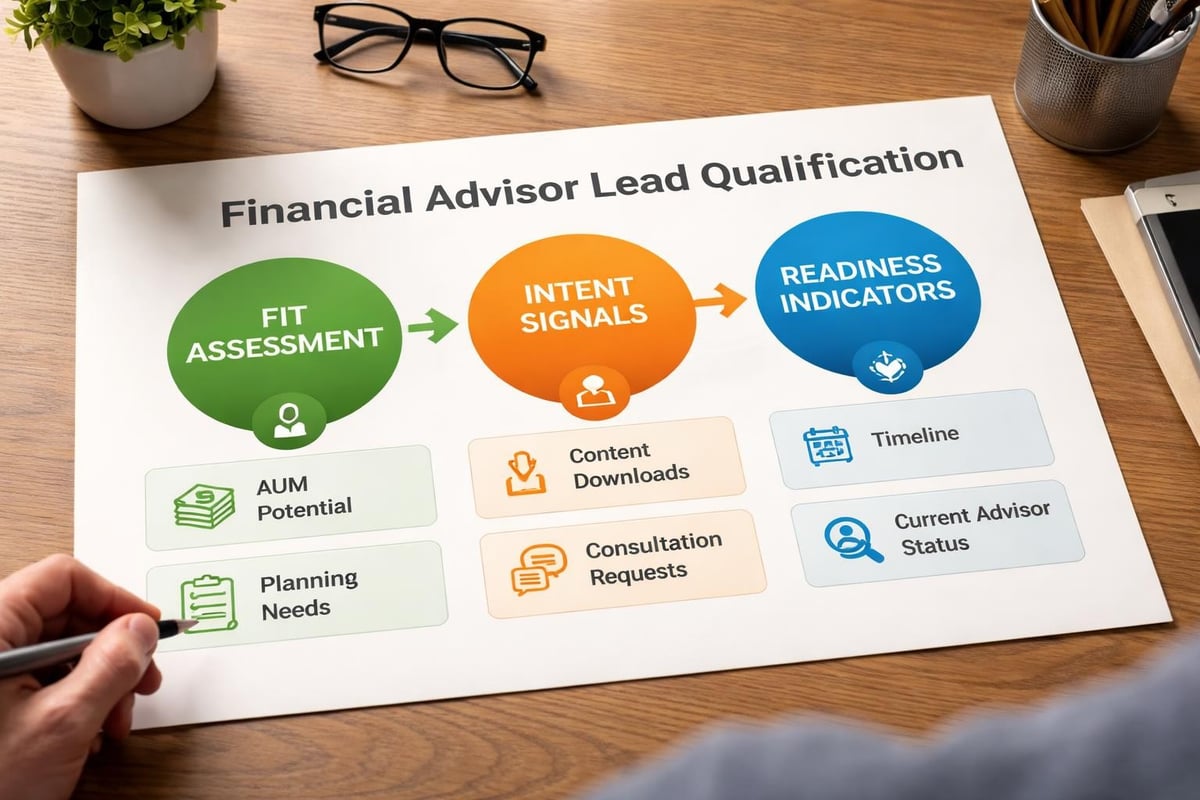
The qualification process involves assessing multiple dimensions of a prospect's readiness. Financial fit examines whether they meet your minimum asset requirements or revenue potential. Behavioral signals reveal their engagement level through actions like downloading resources, attending webinars, or requesting consultations. Timing indicators help determine if they're actively seeking advisory services now or just gathering information for future consideration.
Different types of qualified leads serve distinct purposes in your sales funnel. Marketing Qualified Leads (MQLs) have engaged with your content sufficiently to warrant sales attention, while Sales Qualified Leads (SQLs) have been vetted by your team and confirmed as ready for direct outreach. Understanding these classifications helps financial advisors allocate resources effectively and measure conversion rates accurately.
The Financial Advisor Qualification Framework
Financial advisory practices require specialized qualification criteria beyond standard B2B metrics. Your ideal qualified leads should align with your service model, whether you focus on retirement planning, wealth management, or specialized niches like physicians or business owners.
Key qualification factors include:
- Assets under management potential (minimum thresholds)
- Life stage and financial planning needs
- Current advisory relationship status
- Geographic location and service area fit
- Engagement level with educational content
- Timeline for making advisory decisions
The modern definition of qualified leads has evolved beyond simple demographic matching. Modern revenue models now emphasize the combination of fit, intent, and readiness, requiring advisors to look at behavioral data alongside traditional firmographic information.
Generating Qualified Leads Through Targeted Advertising
For financial advisors, advertising represents one of the most direct paths to attracting qualified leads when executed strategically. Generic ads that target broad audiences typically generate low-quality leads with poor conversion rates and high acquisition costs.
Successful lead generation campaigns start with precise audience targeting. Demographic filters should align with your ideal client profile, focusing on age ranges, income levels, and occupations that match your specialization. Interest-based targeting reaches individuals actively researching retirement planning, investment strategies, or wealth management topics. Behavioral targeting identifies people exhibiting financial planning behaviors online, such as using retirement calculators or researching 401(k) rollovers.
Crafting Ad Creative That Attracts Quality Prospects
The messaging in your advertisements directly influences lead quality. Ads that overpromise returns or use aggressive sales language tend to attract unqualified leads seeking unrealistic outcomes. Instead, educational approaches that offer genuine value tend to pre-qualify prospects by attracting those who appreciate thoughtful financial guidance.
Your ad creative should clearly communicate your value proposition while setting appropriate expectations. Mentioning minimum asset requirements or specializations in your ad copy naturally filters out prospects who aren't a good fit, improving the quality of leads you receive. This transparency saves time for both you and prospects while reducing lead acquisition costs.
| Ad Element | Low-Quality Approach | High-Quality Approach |
|---|---|---|
| Headline | "Guaranteed Returns!" | "Retirement Planning for Medical Professionals" |
| Offer | Free money analysis | Comprehensive financial planning guide |
| Targeting | Age 25-65, all incomes | Age 50-65, $200k+ income, specific professions |
| Landing Page | Generic contact form | Educational content with qualified form |
Integrating the right marketing tools for financial advisors into your campaigns enables better tracking and qualification of incoming leads, ensuring your advertising budget delivers actual prospects rather than information seekers.
Lead Scoring and Qualification Systems
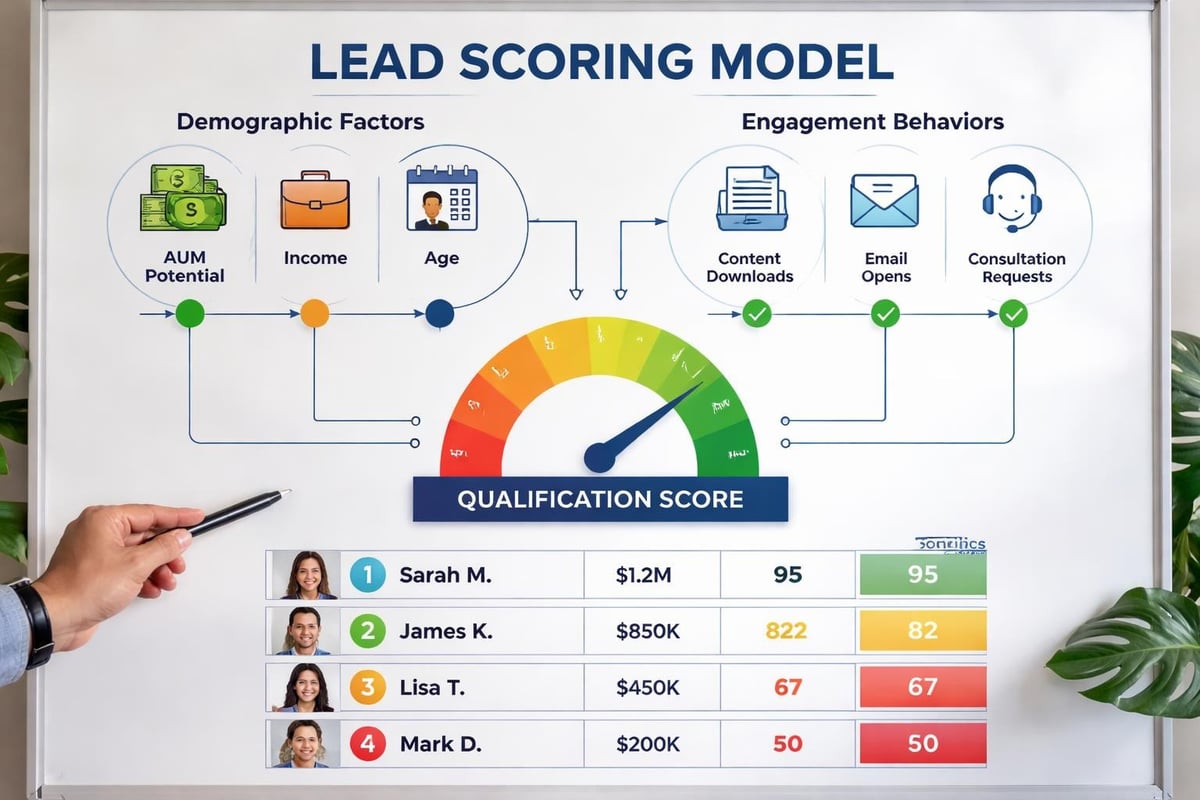
Implementing a systematic approach to evaluating qualified leads prevents subjective decision-making and ensures consistent follow-up prioritization. Lead scoring assigns numerical values to specific attributes and behaviors, creating an objective measure of lead quality.
Demographic scoring criteria:
- Assets available for management (highest weight)
- Annual income level
- Age and proximity to retirement
- Professional occupation category
- Geographic location within service area
Behavioral scoring criteria:
- Website visit frequency and recency
- Content downloads (whitepapers, guides)
- Email engagement rates
- Webinar or event attendance
- Social media interactions
- Consultation request submission
Advanced scoring systems incorporate negative scoring for disqualifying behaviors, such as using free email addresses, browsing career pages, or showing patterns consistent with competitor research. Lead qualification frameworks provide structured methodologies for implementing these systems effectively.
Technology Integration for Qualification
The right CRM system transforms lead qualification from a manual process into an automated workflow. Modern CRM solutions for financial advisors include built-in scoring capabilities, automated tagging, and intelligent routing based on qualification criteria.
When evaluating CRM options, prioritize platforms that allow custom field creation for advisor-specific qualification data. The ability to track AUM potential, current advisory relationships, and compliance-related information distinguishes financial advisory CRMs from generic sales platforms. Your technology stack should seamlessly integrate lead capture forms, email marketing platforms, and your core CRM to maintain data consistency.
Optimizing Landing Pages for Lead Qualification
Your landing pages serve as the critical conversion point where advertising interest transforms into qualified leads. Poor landing page design undermines even the most sophisticated ad campaigns by failing to capture quality information or properly qualify prospects.
Effective financial advisor landing pages balance lead capture with qualification. Progressive profiling allows you to gather essential information without overwhelming prospects with lengthy forms. Initial visits might capture basic contact information, while subsequent interactions request details about assets, planning needs, and timeline.
Form field selection directly impacts both conversion rates and lead quality. Requiring too much information reduces form completions, while collecting too little information produces unqualified leads. The optimal approach includes mandatory fields that serve qualification purposes while keeping optional fields available for prospects willing to share more details.
Essential Landing Page Elements
Your landing pages should clearly communicate value while setting professional expectations. Include trust signals such as professional credentials (CFP, CFA), regulatory compliance statements, and client testimonials when permitted. These elements reassure serious prospects while potentially deterring those seeking questionable services.
High-converting landing page structure:
- Compelling headline addressing specific prospect pain points
- Clear explanation of the offer (guide, consultation, webinar)
- Brief form with strategic qualification fields
- Professional photography and branding elements
- Privacy policy and compliance disclosures
- Social proof elements (where regulatory compliant)
- Responsive design for mobile optimization
Testing different landing page variations reveals which elements most effectively attract qualified leads. A/B testing headline variations, form lengths, and call-to-action buttons provides data-driven insights for continuous improvement.
Nurturing and Converting Qualified Leads
Generating qualified leads represents only the first step in the client acquisition process. Financial advisory services typically involve longer sales cycles than many industries due to the significant trust required and complex decision-making involved. Strategic nurturing campaigns maintain engagement while providing additional qualification opportunities.
Email nurture sequences should deliver genuine educational value rather than constant sales pitches. Share market insights, planning tips, and regulatory updates that demonstrate your expertise while keeping your practice top-of-mind. Each interaction provides behavioral data that further refines lead scoring and qualification status.
Segmentation improves nurture campaign effectiveness by delivering relevant content based on qualification criteria. Prospects nearing retirement receive different content than those in wealth accumulation phases. Those interested in tax planning receive specialized information that deepens engagement while confirming their specific needs.
| Nurture Stage | Content Focus | Qualification Goal |
|---|---|---|
| Initial (Days 1-7) | Educational foundation, practice introduction | Confirm basic interest, gauge engagement |
| Development (Days 8-21) | Specific planning topics, case studies | Identify primary needs, assess readiness |
| Advanced (Days 22-45) | In-depth resources, consultation invitations | Convert to consultation, final qualification |
| Long-term | Periodic insights, market updates | Maintain awareness, identify timing shifts |
Strategies to qualify sales leads faster emphasize the importance of clear qualification criteria and effective communication throughout the nurturing process, ensuring prospects understand your service model and requirements.
Sales Team Alignment and Lead Handoff
The transition from marketing-qualified to sales-qualified status requires clear protocols and strong alignment between marketing and sales functions. Misalignment at this stage results in qualified leads falling through cracks or sales time wasted on unqualified prospects.
Establish specific criteria that trigger lead transfer from marketing to sales. These triggers might include reaching a certain lead score threshold, requesting a consultation, or engaging with high-value content like retirement income calculators. Automated notifications ensure timely follow-up while qualified leads maintain peak interest.
Documentation and Communication Standards
Sales teams need comprehensive context when receiving qualified leads. Your CRM should provide complete visibility into every prospect interaction, content consumed, and behavioral signal collected. This information enables personalized outreach that references specific interests and demonstrated needs.
Essential lead handoff information:
- Complete demographic and firmographic data
- Chronological engagement history
- Lead score and qualification rationale
- Specific interests or pain points indicated
- Preferred communication methods
- Optimal contact timing based on behavior
- Any compliance or regulatory considerations
Regular feedback loops between sales and marketing improve lead quality over time. Sales teams should document lead quality assessments, conversion outcomes, and characteristics of successful client acquisitions. This data refines targeting parameters, scoring models, and qualification criteria for continuous improvement.

Measuring Qualified Lead Performance
Effective measurement transforms qualified lead generation from guesswork into science. Financial advisors should track metrics that reveal both quantity and quality of leads, enabling informed decisions about marketing investments and process improvements.
Key performance indicators include:
- Lead-to-MQL conversion rate
- MQL-to-SQL conversion rate
- SQL-to-client conversion rate
- Cost per qualified lead
- Average time to qualification
- Lead source quality comparison
- Lifetime value by lead source
Cost per qualified lead provides more meaningful insights than simple cost per lead metrics. A campaign generating expensive qualified leads that convert at high rates delivers better ROI than cheap leads requiring extensive nurturing with poor conversion rates. Understanding these economics guides budget allocation across channels and campaigns.
Attribution modeling reveals which touchpoints contribute most to generating qualified leads. Financial advisory prospects typically interact with multiple marketing assets before converting, making single-touch attribution inadequate. Multi-touch models credit various interactions appropriately, showing the true value of awareness-building activities alongside direct response tactics.
Compliance Considerations in Lead Qualification
Financial advisors operate under strict regulatory frameworks that impact lead generation and qualification practices. Advertising claims, privacy handling, and disclosure requirements all influence how you attract and evaluate qualified leads.
FINRA and SEC regulations govern advertising content and testimonial usage. Your lead generation materials must avoid performance guarantees, maintain substantiation for any claims, and include required disclosures. These compliance requirements actually support qualification goals by attracting prospects who appreciate professional, regulated advisory services.
Data privacy regulations, including state-level laws beyond California's CCPA, mandate careful handling of prospect information. Your qualification systems must include proper consent mechanisms, secure data storage, and documented retention policies. Compliance isn't merely about avoiding violations but building trust with privacy-conscious prospects who value fiduciary responsibility.
Building Compliant Qualification Workflows
Your lead qualification process should include compliance checkpoints that verify prospects meet regulatory requirements for your services. Accredited investor verification, suitability assessments, and conflict of interest disclosures all factor into complete qualification beyond simple financial capacity.
Documentation standards for qualified leads should support both sales effectiveness and regulatory requirements. Recording the source of each lead, maintaining consent records, and documenting qualification decisions creates an audit trail while improving process consistency. Choosing a CRM for financial advisors with built-in compliance features simplifies these requirements.
Advanced Strategies for 2026
The qualified lead landscape continues evolving with technological advancement and changing prospect behaviors. Financial advisors who adapt to these shifts maintain competitive advantages in attracting high-quality prospects.
Artificial intelligence tools now assist in lead qualification by analyzing behavioral patterns, predicting conversion likelihood, and optimizing outreach timing. AI tools for financial advisors can process vast amounts of prospect data to identify subtle signals that indicate qualification status, improving both speed and accuracy of lead assessment.
Video content increasingly influences prospect qualification in financial services. Webinars, educational series, and personalized video messages create engagement opportunities while allowing prospects to evaluate your communication style and expertise. Video engagement metrics provide powerful qualification signals, as prospects willing to invest 30-60 minutes watching educational content demonstrate serious interest.
Account-based marketing approaches work particularly well for advisors targeting specific niches or high-net-worth individuals. Rather than broad lead generation, ABM focuses intensive marketing efforts on specifically identified target accounts. This precision naturally produces highly qualified leads, though at lower volume than mass marketing approaches.
Emerging lead qualification trends:
- Conversational AI for initial qualification screening
- Predictive analytics for conversion likelihood
- Intent data from third-party research providers
- Social listening for prospect identification
- Community building as qualification mechanism
- Interactive tools (calculators, assessments) for engagement
Understanding what defines a qualified lead in modern contexts helps advisors stay ahead of industry evolution while maintaining proven fundamental practices.
Mastering qualified lead generation distinguishes thriving financial advisory practices from those struggling with feast-or-famine client acquisition. By implementing systematic qualification frameworks, leveraging appropriate technology, and continuously refining your approach based on performance data, you build a sustainable pipeline of prospects who match your ideal client profile. When you're ready to elevate your lead generation through professionally crafted advertising campaigns designed specifically for financial advisors, Ryan Cook specializes in creating ad services and strategies that attract the qualified leads your practice needs to grow.