Marketing campaigns represent the backbone of business growth for financial advisors seeking to expand their client base and strengthen their brand presence. In an industry built on trust and expertise, creating compelling campaigns requires a strategic blend of personalization, compliance awareness, and measurable results. Whether you're launching your first campaign or refining your approach, understanding the fundamental principles of campaign design, execution, and optimization can transform your marketing efforts from routine outreach into powerful client acquisition tools.
Understanding the Marketing Campaign Framework
The foundation of successful marketing campaigns lies in strategic planning that aligns business objectives with audience needs. Financial advisors must approach campaign development with a clear understanding of their unique value proposition and the specific challenges their ideal clients face.
Defining Campaign Objectives and Metrics
Before launching any campaign, establish precise, measurable objectives that connect directly to business outcomes. Revenue targets, client acquisition numbers, assets under management growth, and brand awareness metrics provide the framework for campaign success evaluation.
Key performance indicators for financial advisor campaigns include:
- Cost per qualified lead
- Conversion rate from prospect to client
- Average client lifetime value
- Return on advertising spend
- Email engagement rates
- Website traffic from campaign sources
These metrics provide concrete data points that inform ongoing optimization and budget allocation decisions. Marketing tools for financial advisors enable precise tracking of these indicators throughout the campaign lifecycle.
Audience Segmentation and Persona Development
Financial advisory services appeal to diverse client segments with distinct needs, concerns, and communication preferences. Pre-retirees focus on wealth preservation and income planning, while younger professionals prioritize growth and tax efficiency.
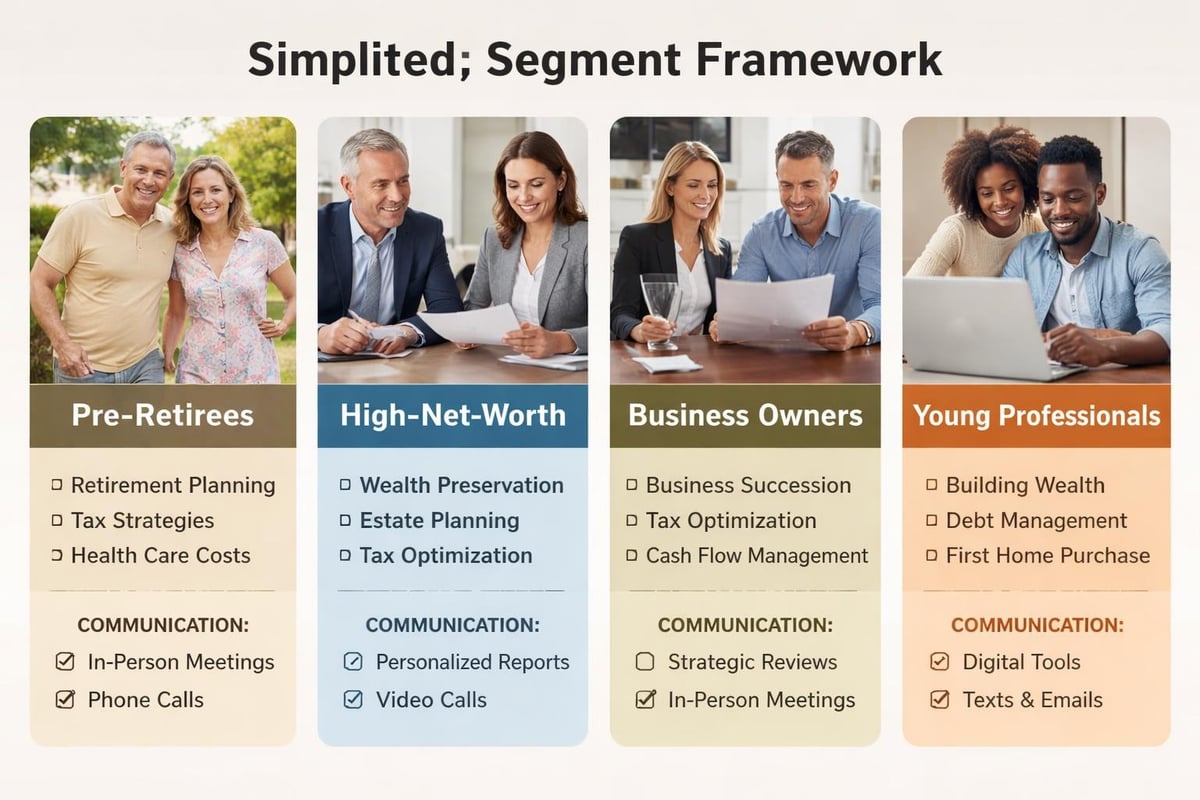
Develop detailed personas that capture demographic information, financial situations, pain points, and preferred communication channels. This specificity transforms generic messaging into personalized communication that resonates with each segment's unique circumstances.
| Client Segment | Primary Concerns | Preferred Channels | Messaging Focus |
|---|---|---|---|
| Pre-Retirees (55-65) | Income planning, healthcare costs | Email, seminars | Security, legacy |
| Young Professionals (30-45) | Wealth building, tax efficiency | Social media, digital ads | Growth, optimization |
| Business Owners | Exit strategies, succession planning | LinkedIn, referrals | Business transition, wealth protection |
| High-Net-Worth | Tax minimization, estate planning | Personal meetings, exclusive events | Sophistication, customization |
Campaign Types and Strategic Applications
Different marketing campaigns serve distinct purposes within your overall marketing strategy. Understanding when and how to deploy each type maximizes campaign effectiveness and resource efficiency.
Content-Driven Educational Campaigns
Educational marketing campaigns position financial advisors as thought leaders while providing genuine value to prospects. These campaigns utilize blog articles, whitepapers, webinars, and video content to address common financial questions and concerns.
The Dove Campaign for Real Beauty demonstrates how challenging industry assumptions through educational content creates powerful brand differentiation. Similarly, financial advisors can challenge common misconceptions about retirement planning, investment strategies, or estate planning.
Effective educational campaign components include:
- Weekly blog posts addressing timely financial topics
- Monthly webinars on specialized planning areas
- Quarterly whitepapers diving deep into complex strategies
- Short-form video explanations for social media platforms
These campaigns generate qualified leads by attracting prospects actively seeking financial guidance while demonstrating your expertise and approach.
Direct Response Advertising Campaigns
Direct response campaigns prioritize immediate action through compelling offers and clear calls to action. These marketing campaigns leverage paid advertising channels including Google Ads, Facebook, LinkedIn, and display networks to reach targeted audiences.
For financial advisors, effective direct response offers include free portfolio reviews, retirement readiness assessments, tax efficiency audits, or educational resources like retirement planning guides. The key lies in creating sufficient perceived value to justify the prospect's contact information exchange.
Prospecting tools for financial advisors integrate seamlessly with direct response campaigns by automating lead capture, qualification, and nurturing processes.
Referral and Client Advocacy Campaigns
Existing clients represent your most valuable marketing asset. Structured referral campaigns systematically encourage satisfied clients to introduce friends, family, and colleagues to your services.
Successful referral marketing campaigns include:
- Client appreciation events that encourage plus-ones
- Referral incentive programs offering value to both parties
- Share-worthy content clients can distribute to their networks
- Testimonial collection and showcase initiatives
The personalization approach used in Coca-Cola’s “Share a Coke” campaign illustrates how making customers the campaign heroes drives organic sharing and advocacy.
Campaign Planning and Execution Excellence
Transforming campaign concepts into results requires meticulous planning and disciplined execution. The most creative campaign ideas fail without proper implementation frameworks.
Campaign Calendar Development
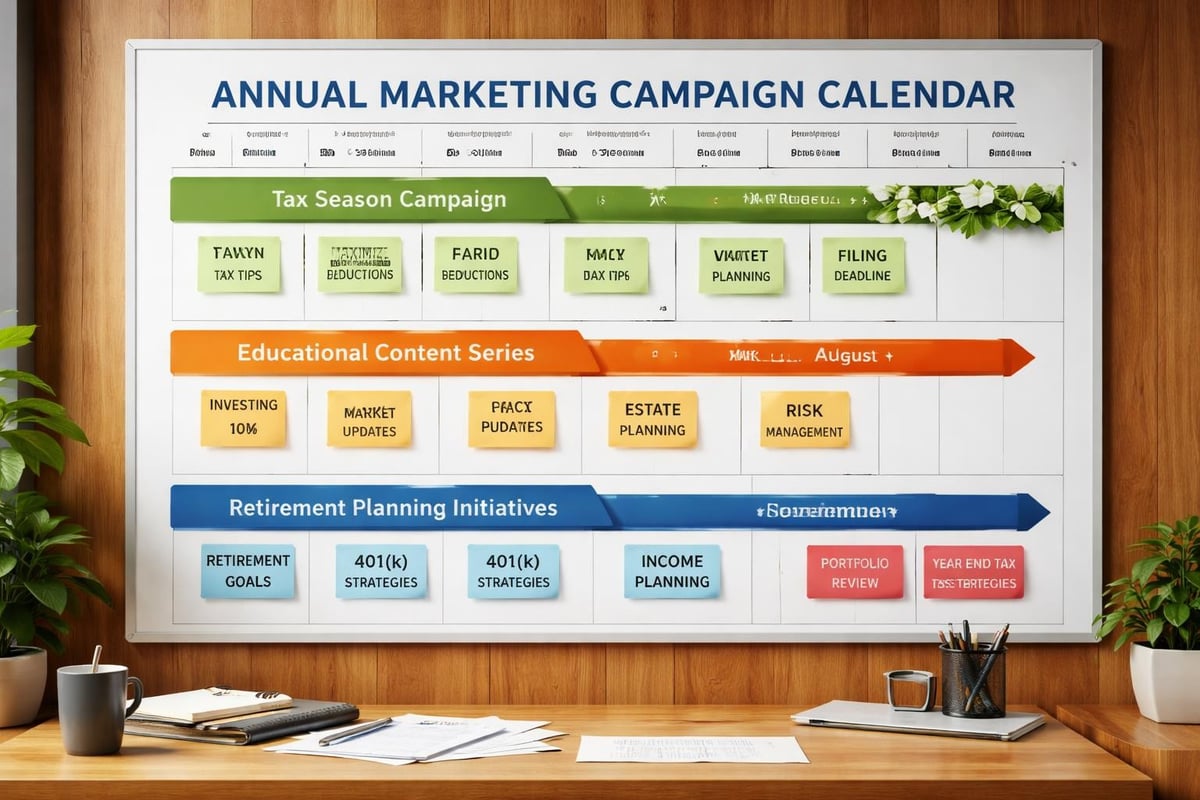
Strategic marketing campaigns follow carefully planned timelines that account for industry seasonality, regulatory considerations, and audience behavior patterns. Financial advisors should align campaigns with tax season, year-end planning periods, and major life events.
A comprehensive campaign calendar maps out:
- Campaign launch and conclusion dates
- Content publication schedules
- Advertising flight dates and budget allocation
- Email deployment sequences
- Social media posting calendars
- Event dates and registration deadlines
This structure ensures consistent messaging across channels while preventing resource conflicts and audience fatigue.
Creative Asset Development and Brand Consistency
Visual and written assets form the tangible components prospects experience. Professional design, compelling copy, and brand consistency across touchpoints build credibility and recognition.
Essential creative assets for financial advisor campaigns:
- Landing pages optimized for conversion
- Email templates maintaining brand identity
- Ad creative in multiple formats and sizes
- Social media graphics and video content
- Print materials for seminars and events
- Presentation decks for educational sessions
Campaign best practices emphasize the importance of planning ahead and developing strong calls to action that guide prospects toward desired actions.
Multi-Channel Integration Strategies
Modern marketing campaigns rarely succeed through single-channel approaches. Integration across email, social media, paid advertising, content marketing, and traditional media creates multiple touchpoints that reinforce messaging and increase conversion probability.
A retirement planning campaign might include:
- LinkedIn ads targeting professionals aged 50-65
- Email sequences to existing prospects discussing retirement concerns
- Blog content addressing common retirement planning mistakes
- Webinar invitation promoting retirement readiness assessment
- Retargeting ads following up with website visitors
- Direct mail to high-value prospect segments
This coordinated approach ensures prospects encounter consistent messaging regardless of their preferred channels.
Data-Driven Campaign Optimization
Continuous improvement separates exceptional marketing campaigns from mediocre efforts. Regular analysis of campaign performance data reveals optimization opportunities and informs future strategy decisions.
Analytics Implementation and Measurement
Comprehensive tracking infrastructure captures campaign performance across all channels and touchpoints. Google Analytics, CRM systems like those compared in RIA CRM solutions, and advertising platform analytics provide the data foundation for informed decisions.
Advanced marketers implement Bayesian Marketing Mix Modeling techniques to assess the effectiveness of various marketing channels and optimize budget allocation based on actual contribution to business outcomes.
| Metric Category | Specific Measures | Optimization Actions |
|---|---|---|
| Acquisition | Click-through rate, cost per click | A/B test ad creative, refine targeting |
| Engagement | Time on site, pages per session | Improve content relevance, enhance user experience |
| Conversion | Form completion rate, consultation bookings | Simplify forms, strengthen offers |
| Retention | Email open rates, content consumption | Segment messaging, improve personalization |
A/B Testing and Iterative Improvement
Systematic testing of campaign variables identifies the specific elements driving performance improvements. Test one variable at a time to isolate impact and build understanding of audience preferences.
High-impact testing opportunities include:
- Email subject lines and preview text
- Landing page headlines and value propositions
- Call-to-action button text and placement
- Ad creative imagery and messaging
- Offer structure and presentation
- Audience targeting parameters
Document all testing results to build institutional knowledge and avoid repeating unsuccessful approaches.
Budget Allocation and ROI Maximization
Financial resources allocated to marketing campaigns represent investments requiring measurable returns. Regular evaluation of channel performance and campaign ROI guides reallocation toward highest-performing tactics.
Calculate true campaign costs including creative development, platform fees, staff time, and technology expenses. Compare these comprehensive costs against qualified leads generated and clients acquired to determine actual return on investment.
Compliance and Ethical Considerations
Financial advisory marketing campaigns operate within strict regulatory frameworks designed to protect consumers. Understanding and adhering to these requirements prevents costly violations while building trust with prospects.
SEC and FINRA Advertising Rules
Securities and Exchange Commission regulations govern investment advisor advertising, prohibiting false or misleading statements, requiring substantiation of performance claims, and mandating specific disclosures.
Marketing campaigns must include appropriate disclaimers, avoid guaranteeing returns, and present balanced perspectives on investment strategies. All testimonials and endorsements require specific disclosures and adherence to detailed requirements.
Review all campaign materials with compliance personnel before deployment to ensure regulatory adherence.
Privacy and Data Protection Standards
Prospect and client data used in marketing campaigns must be handled according to privacy regulations and industry best practices. Obtain explicit consent for email communications, provide clear opt-out mechanisms, and secure personal information against unauthorized access.
Transparency about data collection, usage, and protection builds trust while satisfying legal requirements. Privacy policies should clearly articulate how prospect information supports campaign personalization and service delivery.
Emerging Trends in Financial Advisory Marketing
The marketing landscape continuously evolves with technological advancement and changing consumer preferences. Forward-thinking financial advisors incorporate emerging trends into their campaign strategies.
Video Content and Visual Storytelling
Video consumption continues accelerating across all demographics. Short-form video content on platforms like LinkedIn, YouTube, and Instagram enables financial advisors to explain complex concepts, showcase personality, and build connection with prospects.
Modern marketing approaches emphasize the importance of short-form videos and audio content in contemporary campaigns that resonate with time-constrained professionals.
Educational video series, client success stories, market commentary, and financial planning tips provide diverse content opportunities that support campaign objectives.
Artificial Intelligence and Personalization
AI-powered tools enable unprecedented personalization in marketing campaigns. From predictive lead scoring to dynamic content customization, AI tools for financial advisors enhance campaign effectiveness while reducing manual effort.
Chatbots provide immediate response to prospect inquiries, machine learning algorithms optimize ad delivery timing, and natural language processing personalizes email content based on prospect behavior and preferences.
Innovative Engagement Tactics
Guerrilla marketing strategies and meme marketing techniques demonstrate how unconventional approaches capture attention in crowded markets. While financial advisors must maintain professional credibility, thoughtful adaptation of creative tactics differentiates campaigns.

Interactive tools like retirement calculators, portfolio analyzers, and financial wellness assessments engage prospects while collecting valuable data that informs ongoing campaign personalization.
Campaign Case Studies and Learning
Analyzing successful marketing campaigns from both financial services and adjacent industries provides actionable insights for your own initiatives.
Financial Services Success Stories
Leading advisory firms demonstrate campaign excellence through consistent execution and clear value delivery. Educational seminar series that evolve into ongoing client relationships, targeted LinkedIn campaigns reaching specific professional segments, and referral programs generating predictable new client flow represent proven approaches.
Recent campaign case studies showcase contemporary strategies and their measurable outcomes across diverse industries, offering inspiration for financial advisory applications.
Cross-Industry Application
Marketing principles transcend industry boundaries. The personalization driving retail success applies equally to financial services. The educational value positioning technology companies translates effectively to advisory marketing.
Study campaigns from diverse sectors, extract underlying principles, and adapt them to financial advisory contexts while maintaining regulatory compliance and professional standards.
Technology Stack for Campaign Management
Effective marketing campaigns require robust technology infrastructure supporting planning, execution, tracking, and optimization activities.
Essential technology components include:
- Customer Relationship Management system for lead management
- Marketing automation platform for email and nurturing
- Analytics tools for performance measurement
- Social media management software for scheduling and monitoring
- Landing page builders for conversion optimization
- Project management tools for team coordination
Software for financial advisors should integrate seamlessly to create unified workflows and centralized data repositories that inform campaign decisions.
The best practices for campaign management include conducting regular retrospectives, maintaining organized asset libraries, and developing reusable templates that accelerate future campaign deployment.
Building Campaign Sustainability
Long-term marketing success requires systems and processes that support consistent campaign execution regardless of market conditions or staffing changes.
Documentation and Process Development
Create detailed standard operating procedures for recurring campaign types. Document targeting criteria, messaging frameworks, creative specifications, deployment checklists, and measurement protocols.
This documentation enables delegation, ensures consistency, and preserves institutional knowledge when team members transition.
Resource Allocation and Team Structure
Determine whether to build internal marketing capabilities, outsource to specialized agencies, or pursue hybrid approaches. Each model offers distinct advantages depending on budget, desired control level, and internal expertise.
Many financial advisors find value in partnering with marketing services specialists who understand industry regulations while bringing campaign execution expertise.
Continuous Learning and Adaptation
Marketing effectiveness requires ongoing education about evolving platforms, changing audience preferences, and emerging best practices. Dedicate time to industry publications, attend marketing conferences, and participate in peer learning groups.
Test new approaches systematically, measure results rigorously, and adapt strategies based on data rather than assumptions. The marketing campaigns delivering exceptional results today may underperform tomorrow as competitive dynamics and consumer behaviors shift.
Successful marketing campaigns combine strategic planning, creative execution, rigorous measurement, and continuous optimization to deliver predictable client acquisition results. By implementing the frameworks and best practices outlined above, financial advisors can build sustainable marketing systems that generate consistent growth. When you're ready to elevate your advertising efforts with professionally crafted campaigns designed specifically for the financial advisory industry, Ryan Cook delivers specialized ad services that convert prospects into clients while maintaining full regulatory compliance.