A lead gen campaign represents one of the most powerful tools financial advisors can leverage to build a sustainable client pipeline. With the right strategy, ad creation, and targeting approach, these campaigns transform strangers into qualified prospects who actively seek your expertise. The financial advisory industry demands precision in client acquisition, making structured lead generation essential for growth in 2026.
Understanding Lead Gen Campaign Fundamentals
A lead gen campaign differs significantly from brand awareness advertising. Rather than simply introducing your services to potential clients, these campaigns focus on capturing contact information from prospects who demonstrate genuine interest in financial planning services. This approach creates measurable pathways from initial contact to scheduled consultations.
The foundation of any successful lead gen campaign starts with understanding your ideal client profile. Financial advisors must identify specific demographics, asset levels, and financial pain points that align with their service offerings. This precision ensures every dollar spent on advertising reaches prospects most likely to convert into long-term clients.
Core Components of Effective Campaigns
Every lead gen campaign requires several critical elements working in harmony:
- Compelling offer: A valuable resource that motivates prospects to share contact information
- Targeted ad creative: Visuals and messaging that resonate with specific prospect segments
- Optimized landing page: A conversion-focused page designed to capture leads efficiently
- Follow-up system: Automated and manual touchpoints that nurture leads toward consultations
- Tracking infrastructure: Analytics that measure campaign performance and ROI

Financial advisors who excel at lead generation understand that AI tools for financial advisors can significantly enhance campaign efficiency. Modern platforms automate repetitive tasks while providing insights that improve targeting precision and conversion rates.
Crafting High-Converting Offers for Financial Services
The offer serves as the cornerstone of your lead gen campaign. In financial services, prospects rarely provide contact information without receiving substantial value in return. Your offer must address specific concerns while positioning you as a trusted expert capable of solving complex financial challenges.
Educational content typically performs exceptionally well for financial advisors. Comprehensive guides, calculators, webinars, and personalized assessments all provide immediate value while demonstrating expertise. The key lies in matching the offer complexity to your target audience's sophistication level.
| Offer Type | Best For | Typical Conversion Rate | Lead Quality |
|---|---|---|---|
| Retirement Planning Guide | Pre-retirees | 15-25% | High |
| Investment Calculator | Accumulation Phase | 20-30% | Medium |
| Tax Strategy Webinar | High Net Worth | 10-18% | Very High |
| Financial Health Assessment | General Audience | 25-35% | Medium |
Developing Valuable Lead Magnets
Creating effective lead magnets requires understanding prospect psychology. Financial decisions carry significant emotional weight, so your offer must address both rational and emotional concerns. According to best practices for generating high-quality leads, leveraging AI-powered campaigns can substantially improve lead verification methods and overall quality.
Consider developing tiered offers that segment prospects based on engagement level. A basic retirement checklist might attract early-stage researchers, while a comprehensive estate planning guide appeals to prospects closer to making advisor decisions. This stratification allows for more precise nurturing sequences matched to prospect readiness.
The presentation of your offer matters as much as its content. Professional design, clear value propositions, and minimal friction points during the download or registration process all contribute to higher conversion rates. Many financial advisors see conversion improvements of 30-40% simply by optimizing their lead capture forms.
Targeting Strategies for Financial Advisor Campaigns
Precise targeting separates profitable lead gen campaigns from expensive experiments. Financial advisors must balance broad reach with specific qualification criteria to ensure advertising budgets generate qualified prospects rather than tire-kickers.
Demographics provide the starting foundation for campaign targeting. Age ranges, income levels, geographic location, and employment status all serve as initial filters. However, behavioral and interest-based targeting often delivers superior results by identifying prospects actively researching financial solutions.
Platform-Specific Targeting Approaches
Different advertising platforms offer unique targeting capabilities:
Facebook and Instagram excel at lifestyle-based targeting, allowing advisors to reach prospects based on life events, interests, and behaviors. Financial advisors can target users who recently experienced job changes, received inheritances, or demonstrated interest in retirement planning content.
Google Ads captures intent-driven prospects actively searching for financial guidance. Search campaigns targeting specific keywords like "retirement planning near me" or "financial advisor for business owners" connect with high-intent prospects at critical decision moments.
LinkedIn provides unparalleled professional targeting for advisors serving business owners, executives, or specific industries. Job titles, company sizes, and professional interests enable precise audience segmentation impossible on other platforms.
The ultimate guide to lead gen strategies emphasizes how webinars and events can complement digital advertising, creating multi-channel approaches that reinforce messaging across touchpoints.
Creating Compelling Ad Creative
Ad creative determines whether prospects engage with your lead gen campaign or scroll past without notice. Financial services advertising faces unique challenges, balancing regulatory compliance with persuasive messaging that motivates action.
Visual elements must convey professionalism while remaining approachable. Stock photography featuring relatable scenarios-families discussing finances, couples planning retirement, or business owners reviewing documents-generally outperforms abstract financial imagery. Authenticity resonates more powerfully than polished perfection in 2026's advertising landscape.
Messaging That Converts Prospects
Your ad copy must accomplish multiple objectives simultaneously: capture attention, establish credibility, communicate value, and motivate immediate action. This complexity requires careful word selection and message hierarchy.
- Lead with the prospect's primary concern or aspiration
- Quantify specific outcomes when possible (e.g., "Reduce tax liability by up to 30%")
- Address common objections preemptively in ad copy
- Create urgency without appearing manipulative
- Include clear calls-to-action that specify next steps
Many financial advisors leverage marketing tools for financial advisors to streamline ad creation and ensure compliance across campaigns. These platforms often include pre-approved templates and automated compliance checks that reduce legal risks while maintaining creative flexibility.
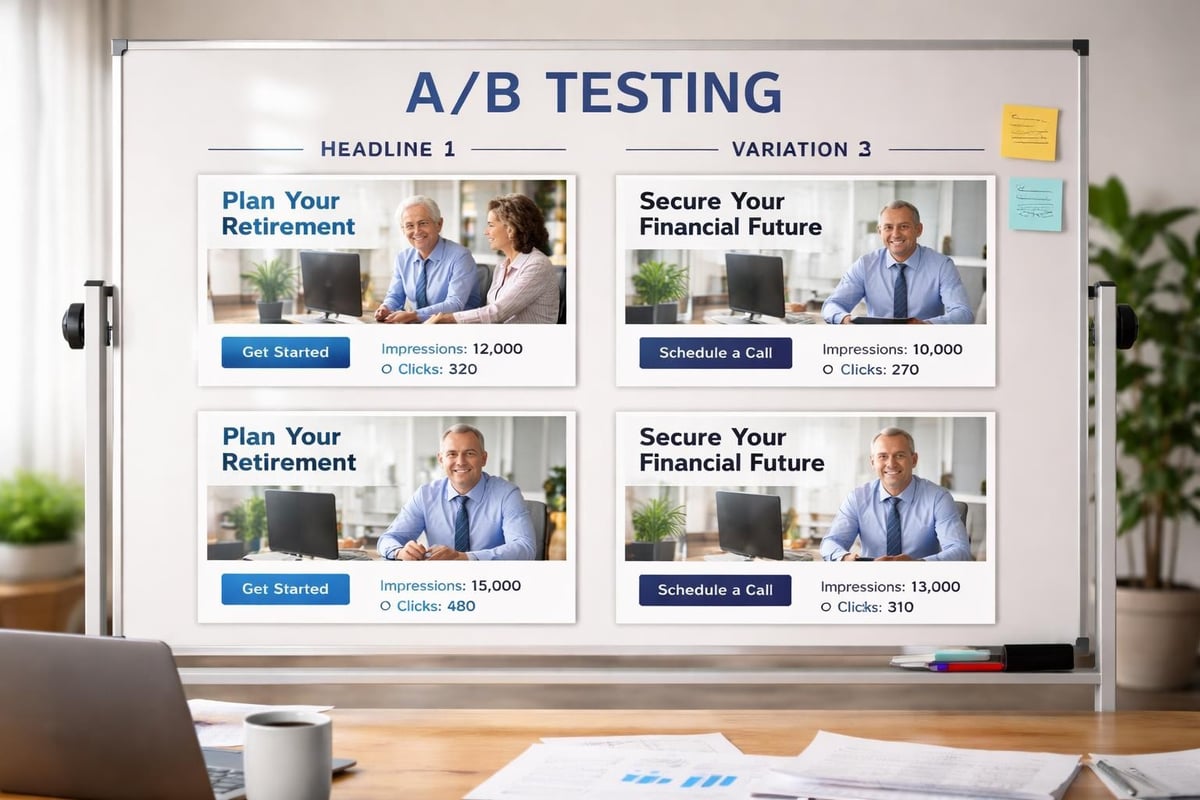
Testing represents the only reliable path to optimization. Running multiple ad variations simultaneously reveals which messaging resonates most powerfully with your target audience. Small changes in headlines, images, or calls-to-action frequently produce dramatic conversion differences.
Landing Page Optimization for Maximum Conversions
Even the most compelling ad creative fails without an equally optimized landing page. The transition from ad click to form submission represents the most critical conversion point in any lead gen campaign. Every element on your landing page must support the singular goal of capturing prospect information.
Successful landing pages maintain message consistency with the originating ad. Prospects who click an ad about retirement planning should arrive at a page specifically addressing retirement concerns, not a generic financial services overview. This alignment reduces confusion and builds trust by delivering on expectations.
Essential Landing Page Elements
A high-converting landing page for financial advisors includes:
- Attention-grabbing headline that matches the ad promise
- Subheadline providing additional context and benefit clarification
- Compelling hero image showing the offer or desired outcome
- Benefit-focused bullet points explaining what prospects receive
- Trust indicators including credentials, testimonials, and security badges
- Simple form requesting only essential information
- Strong call-to-action clearly stating what happens after submission
- Privacy statement addressing data protection concerns
According to research from Sales Leads CRM on best practices, providing upfront value while capturing essential contact details significantly improves conversion rates. The balance between information requested and value provided directly impacts form completion rates.
Form optimization deserves particular attention. Every additional field reduces conversion rates, yet insufficient information hampers lead qualification. Financial advisors typically achieve optimal results by requesting name, email, phone number, and one qualifying question during initial capture, then gathering additional details during follow-up conversations.
Nurturing Leads Through Strategic Follow-Up
Capturing contact information represents only the beginning of the lead gen campaign journey. Most financial advisor prospects require multiple touchpoints before scheduling consultations. A structured nurture sequence transforms initial interest into scheduled meetings.
Immediate follow-up proves essential. Prospects expect rapid responses after submitting information, with studies showing that contacting leads within five minutes increases conversion probability by 400% compared to waiting 30 minutes. Automated systems ensure no lead falls through cracks during business hours or after hours.
Multi-Channel Nurture Sequences
Effective nurturing employs multiple communication channels strategically:
| Channel | Best Use | Timing | Conversion Impact |
|---|---|---|---|
| Educational content delivery | Days 1, 3, 7, 14 | High | |
| Phone | Personal connection and qualification | Day 1 or 2 | Very High |
| SMS | Appointment reminders and quick updates | As needed | Medium |
| Retargeting Ads | Reinforcement and re-engagement | Continuous | Medium-High |
The case study from MarketingSherpa demonstrates how developing lead generation offers with the same care as new products, combined with email and SMS nurturing, produces substantially better outcomes than single-channel approaches.
Content provided during nurturing must progress prospects toward decision-making. Early touches should educate and build trust, while later communications address specific objections and facilitate scheduling. This progression mirrors the prospect's psychological journey from awareness to commitment.
Integration with comprehensive CRM solutions for financial advisors ensures consistent tracking and prevents redundant outreach. Modern systems automatically segment leads based on behavior, trigger appropriate nurture sequences, and alert advisors when prospects demonstrate high engagement.
Measuring and Optimizing Campaign Performance
Data-driven optimization separates profitable lead gen campaigns from those that drain budgets without delivering results. Financial advisors must track specific metrics that reveal campaign health and identify improvement opportunities.

Primary metrics for lead gen campaign evaluation include:
- Cost per lead (CPL): Total advertising spend divided by leads generated
- Lead-to-appointment conversion rate: Percentage of leads scheduling consultations
- Appointment-to-client conversion rate: Percentage of consultations becoming clients
- Customer acquisition cost (CAC): Total campaign cost divided by new clients acquired
- Return on ad spend (ROAS): Revenue generated relative to advertising investment
- Lead quality score: Subjective rating of lead fit and readiness
Benchmark performance varies significantly by target market and service offering. Advisors targeting pre-retirees with $500,000+ in investable assets typically experience different economics than those serving young professionals. Establishing personal benchmarks based on initial campaigns provides more relevant comparison points than industry averages.
Continuous Improvement Strategies
Optimization represents an ongoing process rather than a one-time adjustment. The most successful financial advisors implement systematic testing schedules that evaluate campaign components methodically.
Start by identifying the largest constraint in your conversion funnel. If ads generate clicks efficiently but landing page conversions lag, focus optimization efforts there rather than on ad creative. This constraint-focused approach produces faster improvements than scattered testing across all campaign elements.
Advanced advertisors leverage multivariate testing to evaluate multiple variables simultaneously. However, simpler A/B tests often provide clearer insights for advisors new to lead gen campaigns. Test one element at a time-headline, image, form length, or call-to-action-to isolate which changes drive performance improvements.
Budget Allocation and Scaling Strategies
Strategic budget management enables sustainable growth through lead gen campaigns. Financial advisors must balance aggressive client acquisition with profitability constraints, ensuring each campaign dollar generates positive returns.
Initial campaigns typically require experimental budgets that prioritize learning over immediate profitability. Allocating $2,000-$5,000 for testing provides sufficient data to identify winning combinations of targeting, creative, and offers. This investment phase establishes baseline metrics that guide scaling decisions.
Profitable Scaling Framework
Once campaigns demonstrate consistent profitability, systematic scaling amplifies results without proportionally increasing risk:
- Horizontal scaling: Expand successful campaigns to additional geographic markets or demographic segments
- Vertical scaling: Increase budgets on proven campaigns while maintaining efficiency metrics
- Creative expansion: Develop additional ad variations that appeal to different prospect motivations
- Offer diversification: Create multiple lead magnets that attract prospects at various awareness levels
- Platform expansion: Replicate successful strategies across additional advertising channels
The case studies available at VirtuWise showcase how successful B2B lead generation campaigns scale across industries, providing frameworks adaptable to financial advisory contexts.
Risk management during scaling prevents budget waste. Implement incremental budget increases of 20-30% weekly rather than doubling spend overnight. Monitor key efficiency metrics daily during scaling periods, quickly reducing budgets if cost per lead or conversion rates deteriorate beyond acceptable thresholds.
Compliance Considerations for Financial Services
Financial advisor lead gen campaigns must navigate complex regulatory requirements that don't constrain other industries. Understanding these compliance obligations prevents costly violations while maintaining campaign effectiveness.
All advertising claims require substantiation. Promises about returns, performance, or outcomes must align with actual capabilities and historical results. Avoid absolute statements ("guaranteed returns") or comparisons that mislead prospects about risk levels or expected results.
Required Disclosures and Documentation
Advertising compliance demands specific disclosures depending on messaging and platform:
- Investment performance claims require corresponding time periods and benchmark comparisons
- Testimonials need disclaimers indicating results aren't typical or guaranteed
- Professional designations must be current and relevant to services advertised
- Firm registration status should be clearly stated on landing pages
- Privacy policies must explain how prospect data is collected and used
Maintaining comprehensive documentation of all advertising materials, targeting parameters, and performance metrics supports regulatory examinations. Many advisors retain advertising archives for seven years, matching typical record-keeping requirements for client communications.
Working with compliance specialists during campaign development prevents violations before launch. The investment in pre-approval processes substantially outweighs penalties, reputation damage, or mandated campaign suspension resulting from regulatory issues.
Integrating Lead Gen With Overall Marketing Strategy
Lead gen campaigns function most effectively as components of comprehensive marketing strategies rather than isolated tactics. Integration with content marketing, social media presence, and referral programs creates synergistic effects that amplify individual channel performance.
Content marketing supports lead gen campaigns by establishing authority and trust before prospects see paid advertisements. Financial advisors who consistently publish valuable insights through blogs, videos, or podcasts benefit from brand recognition that improves ad engagement and conversion rates. Utilizing platforms like Bizware can help coordinate these multi-channel efforts efficiently.
Retargeting represents a powerful integration point between organic and paid efforts. Prospects who visit your website through organic search or social media can be added to custom audiences that see targeted ads reinforcing your messaging. This multi-touch approach keeps your services top-of-mind during extended decision-making periods typical in financial services.
Referral programs and lead gen campaigns complement each other strategically. While campaigns acquire new prospects continuously, referral systems leverage satisfied clients to generate lower-cost, higher-quality leads. Balancing both approaches reduces dependence on any single acquisition channel while optimizing overall client acquisition costs.
Implementing a successful lead gen campaign requires strategic planning, continuous optimization, and deep understanding of your target audience. Financial advisors who master these fundamentals build sustainable client pipelines that support long-term practice growth. Whether you're launching your first campaign or refining existing efforts, the frameworks outlined here provide actionable pathways to improved results. Ryan Cook specializes in ad services and ad creation designed specifically for financial advisors, helping you develop campaigns that attract qualified prospects and convert them into valuable long-term clients.