Facebook campaigns have become an essential component of digital marketing strategies for financial advisors seeking to expand their client base and establish authority in wealth management. With over 2.9 billion active users, Facebook's advertising platform offers unprecedented access to specific demographic segments, particularly affluent individuals approaching retirement or seeking investment guidance. The platform's sophisticated targeting capabilities enable financial services professionals to reach prospects based on income, life events, professional status, and behavioral indicators that signal readiness for financial planning services.
Understanding Facebook Campaign Structure for Financial Services
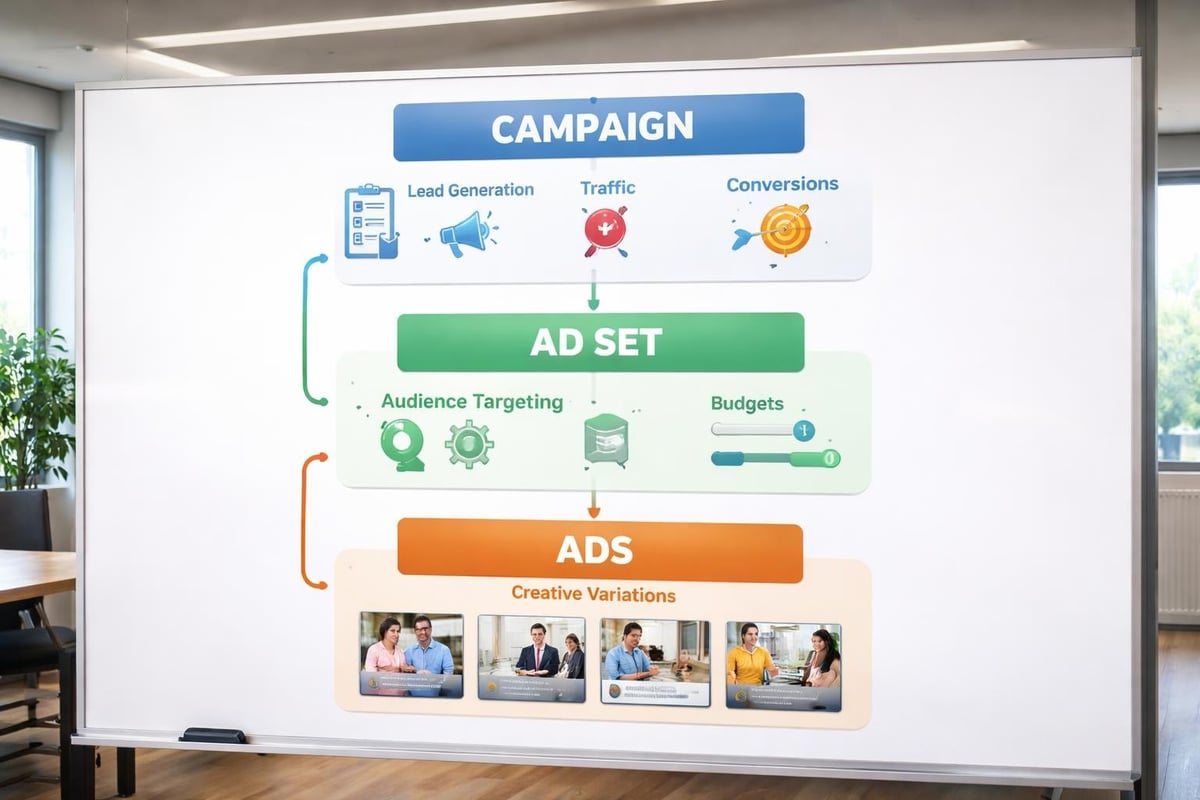
Facebook campaigns operate on a three-tier hierarchy that determines how your advertising budget is allocated and how your message reaches potential clients. At the top level, the campaign defines your overall objective, whether that's generating leads, driving website traffic, or building brand awareness among your target demographic.
The ad set level controls critical elements including audience targeting, placement selection, budget allocation, and schedule. For financial advisors, this is where you define parameters such as age ranges (typically 45-65 for retirement planning), household income thresholds, and geographic boundaries that align with your licensing and service areas.
Individual ads represent the creative execution of your strategy, featuring specific headlines, ad copy, images, and calls-to-action. Testing multiple ad variations within a single ad set allows you to identify which messaging resonates most effectively with prospects seeking financial guidance.
Campaign Objectives That Drive Results
Lead generation campaigns remain the most effective objective for financial advisors building their practice. These campaigns use Facebook's native lead forms, capturing contact information without requiring prospects to leave the platform. The reduced friction significantly improves conversion rates compared to directing traffic to external landing pages.
Traffic campaigns work well when you've invested in comprehensive educational content on your website. Driving prospects to detailed guides about retirement planning, tax strategies, or estate planning establishes your expertise while warming leads for future conversion.
Awareness campaigns build recognition within your local market or among specific professional communities. While these don't generate immediate leads, they create familiarity that improves performance of subsequent conversion-focused campaigns.
Audience Targeting Strategies for Financial Advisory Firms
The power of facebook campaigns lies in precision targeting capabilities that allow you to reach individuals most likely to need financial services. Demographic targeting forms the foundation, focusing on age ranges that correspond with major life events like career peaks, inheritance, or retirement planning.
Income-based targeting requires careful navigation since Facebook doesn't directly offer income filtering. Instead, successful advisors layer multiple indicators including ZIP codes associated with higher household incomes, job titles in executive or professional categories, and educational attainment levels that correlate with earning potential.
Behavioral and interest-based targeting includes:
- Users who engage with investment-related content
- People interested in retirement planning
- Individuals following financial publications or thought leaders
- Those who have engaged with business or entrepreneurial content
- Prospects showing interest in real estate investing
Life event targeting presents unique opportunities for financial advisors. Facebook identifies users experiencing marriages, home purchases, job changes, or approaching retirement milestones. These transitions often trigger the need for financial planning services, making these audiences particularly valuable.
Custom Audiences and Lookalike Expansion
Custom audiences allow you to upload client email lists or website visitor data to create highly targeted campaigns. For financial advisors, this enables retention campaigns aimed at existing clients while excluding them from prospecting efforts to optimize budget allocation.
Lookalike audiences leverage Facebook's algorithm to identify users who share characteristics with your best clients. A lookalike audience based on your top 100 clients by assets under management can dramatically improve lead quality compared to cold prospecting. According to best practices outlined by Social Media Today, lookalike audiences consistently outperform interest-based targeting for service providers.
Compliance Considerations for Financial Advisor Facebook Campaigns
Running facebook campaigns in the financial services industry requires strict adherence to regulatory requirements from FINRA, SEC, and state securities regulators. Every advertisement must be archived, approved, and compliant with advertising rules that govern claims, testimonials, and disclosures.
All performance claims require substantiation and appropriate disclaimers. Phrases like "guaranteed returns" or "risk-free investing" violate securities regulations and can result in enforcement actions. Even seemingly innocuous statements about market timing or specific investment recommendations may trigger compliance reviews.
Key compliance requirements include:
- Maintaining records of all advertisements for required retention periods
- Implementing supervisory review processes before ads go live
- Including appropriate disclosures about advisory services and compensation
- Avoiding testimonials unless your firm has specific policies permitting them
- Ensuring any third-party content or statistics include proper attribution
Many financial advisors utilize specialized marketing tools for financial advisors that include compliance review workflows and archiving capabilities specifically designed for regulated industries. These tools streamline the approval process while ensuring campaigns meet regulatory standards.

Creative Best Practices for Financial Services Ads
The visual and messaging components of your facebook campaigns determine whether prospects engage with your content or scroll past. Financial services advertising faces unique creative challenges, balancing professionalism with approachability while communicating complex value propositions concisely.
Image selection should emphasize trust and expertise without appearing sterile or unapproachable. Real photos of your team, your office, or you working with clients (with appropriate permissions) outperform stock photography. Avoid generic images of money, graphs, or suited executives that blend into the sea of financial services advertising.
Messaging That Resonates With Prospects
Headlines must immediately communicate specific value rather than generic platitudes. "Retirement Planning for Medical Professionals" outperforms "Expert Financial Advice" because it speaks to a defined audience with specific needs. Successful advisors identify niche markets and craft messaging that addresses unique challenges those segments face.
Ad copy should focus on outcomes and solutions rather than credentials or processes. While your CFP designation and experience matter, prospects care more about whether you can help them retire comfortably or fund their children's education. Leading with benefits and supporting with credentials creates more compelling ads.
Effective calls-to-action for financial advisor campaigns:
- Schedule a complimentary portfolio review
- Download our retirement readiness checklist
- Register for our upcoming tax planning webinar
- Request our comprehensive estate planning guide
- Book a 15-minute consultation call
The case studies compiled by Adweek demonstrate that specific, low-friction CTAs consistently outperform vague requests to "learn more" or "contact us." Prospects at the awareness stage need educational offers, while those further in the buyer journey respond to consultation requests.
Budget Allocation and Bidding Strategies
Financial advisors often struggle with budget decisions for facebook campaigns, uncertain whether to invest aggressively or test conservatively. The lifetime value of a financial planning client typically ranges from $5,000 to $50,000 or more, justifying higher cost-per-lead thresholds than most industries can support.
Starting with a test budget of $1,500-$3,000 per month allows sufficient data collection to optimize targeting and creative elements. This budget supports running multiple ad sets simultaneously, testing different audience segments and messaging approaches to identify the most cost-effective combinations.
| Budget Level | Monthly Investment | Expected Leads | Cost Per Lead | Best For |
|---|---|---|---|---|
| Test | $1,500-$3,000 | 15-30 | $75-$150 | New advisors testing Facebook |
| Growth | $3,000-$7,500 | 30-75 | $60-$125 | Established practices scaling |
| Aggressive | $7,500-$15,000+ | 75-150+ | $50-$100 | Firms with proven conversion funnels |
Bidding strategies significantly impact campaign performance and efficiency. Automatic bidding allows Facebook's algorithm to optimize delivery based on your objective, generally recommended for advisors new to the platform. Manual bidding provides more control but requires ongoing monitoring and adjustment based on performance data.
Campaign Budget Optimization
Campaign budget optimization (CBO) shifts budget allocation decisions from the ad set level to the campaign level, allowing Facebook to automatically distribute spending toward the best-performing audiences and placements. For financial advisors running multiple audience tests, CBO can improve overall efficiency by 15-25% compared to manual budget allocation.
However, CBO requires sufficient total budget to function effectively. Running CBO with less than $100 daily budget often results in premature audience elimination before statistical significance is achieved. Many advisors find success starting with ad set budgets, then transitioning to CBO once winning audiences are identified.
Conversion Tracking and Performance Measurement
Effective facebook campaigns require comprehensive tracking to connect advertising spend with actual client acquisition. The Facebook Pixel, a snippet of code installed on your website, tracks user behavior including page views, form submissions, and consultation bookings.
For financial advisors, tracking should extend beyond initial lead capture to measure lead quality and ultimate conversion to clients. Integrating your Facebook campaigns with your CRM solutions for financial advisors enables closed-loop reporting that attributes new clients to specific campaigns, ad sets, and even individual ads.
Key performance indicators for financial advisor campaigns:
- Cost per lead (CPL)
- Lead-to-consultation conversion rate
- Consultation-to-client conversion rate
- Cost per client acquisition
- Return on ad spend based on first-year revenue
- Lifetime value of acquired clients
Quality metrics matter as much as volume metrics. A campaign generating 50 leads at $50 each appears successful until you discover none convert to consultations. Conversely, 10 leads at $200 each might deliver 3 new clients with $150,000 in assets under management, representing exceptional ROI.

Advanced Tactics for Scaling Successful Campaigns
Once you've identified winning combinations of audiences, creative, and messaging, scaling facebook campaigns requires strategic approach to maintain performance while increasing reach. Simply doubling budget rarely doubles results due to audience saturation and increased competition at higher spending levels.
Horizontal scaling involves creating additional ad sets targeting similar but distinct audiences. If your campaign successfully targets business owners aged 50-60, horizontal scaling might add ad sets for executives, medical professionals, or entrepreneurs in the same age range. This expands reach without exhausting your initial audience.
Vertical scaling increases budget for existing high-performing ad sets, typically in 20-25% increments every 3-4 days. Gradual increases allow Facebook's algorithm to adjust delivery without triggering the learning phase reset that occurs with dramatic budget changes. Strategies outlined by MyIDCM emphasize patience in scaling to preserve cost efficiency.
Retargeting Campaigns for Nurturing Leads
Retargeting campaigns re-engage prospects who've interacted with your initial ads but haven't converted. These campaigns target custom audiences based on website visitors, video viewers, or users who engaged with your Facebook page or previous ads.
For financial advisors, retargeting serves the extended consideration period typical in financial services decisions. A prospect might need 6-12 touchpoints before scheduling a consultation, making consistent retargeting essential for maximizing conversion rates from your facebook campaigns.
Sequential retargeting delivers progressively deeper content based on engagement level. Initial ads might offer educational content, followed by case studies or client success stories for engaged prospects, and finally consultation offers for those who've consumed multiple content pieces.
Testing and Optimization Framework
Continuous testing separates mediocre facebook campaigns from exceptional ones. A/B testing isolates variables to determine which elements drive performance improvements, whether that's audience characteristics, ad creative, copy variations, or placement strategies.
Effective testing requires discipline to change only one variable at a time. Testing three headlines simultaneously across five audience segments creates 15 variations, making it impossible to identify which specific element improved performance. Instead, test headlines with a consistent audience and creative, then test audiences with your winning headline.
High-impact elements to test systematically:
- Headline variations emphasizing different value propositions
- Image selections featuring advisors, clients, or conceptual imagery
- Audience segments based on demographics, interests, or behaviors
- Ad formats including single image, carousel, or video
- Placement selections across Facebook, Instagram, Audience Network
Statistical significance matters in evaluating test results. A campaign with 15 conversions from 500 impressions hasn't necessarily outperformed one with 12 conversions from 500 impressions. Most experts recommend at least 100 conversions per variation before drawing conclusions, though financial advisors working with lower lead volumes may use 25-50 conversions as their threshold.
The case study from Strike Social demonstrates how systematic testing and optimization achieved 28x return on ad spend, emphasizing that breakthrough results come from incremental improvements across multiple campaign elements rather than single dramatic changes.
Integration with Broader Marketing Strategy
Facebook campaigns deliver optimal results when integrated into a comprehensive marketing ecosystem rather than operating in isolation. Content marketing, email nurturing, and remarketing work synergistically with paid social to guide prospects through the buyer journey.
Successful financial advisors use facebook campaigns at multiple funnel stages. Top-of-funnel awareness campaigns introduce your brand and expertise to cold audiences through valuable content like market commentaries, planning guides, or educational videos. Middle-funnel campaigns retarget engaged prospects with deeper content like webinar invitations or case studies. Bottom-funnel campaigns target warm leads with consultation offers and testimonials.
Coordinating your facebook campaigns with your digital tools for financial advisors creates seamless prospect experiences. Marketing automation platforms can trigger email sequences when prospects download lead magnets from Facebook ads, nurturing them toward consultation readiness even if they don't immediately book a meeting.
Furthermore, integrating campaign data with your prospecting tools for financial advisors enables sophisticated lead scoring that prioritizes follow-up based on engagement signals. A prospect who watches 75% of your retirement planning video deserves different treatment than one who only viewed your ad.
Mobile Optimization Imperatives
Over 94% of Facebook users access the platform via mobile devices, making mobile optimization non-negotiable for successful facebook campaigns. Ads, landing pages, and conversion processes must deliver flawless experiences on smartphones and tablets to avoid losing prospects to friction.
Mobile-first creative uses large, legible text overlays, minimal word count, and vertical or square aspect ratios that maximize screen real estate. Horizontal images cropped from desktop campaigns often render poorly on mobile, with key elements cut off or text becoming unreadable.
Landing page mobile optimization extends beyond responsive design to address mobile-specific user behaviors. Forms should minimize required fields, use mobile-friendly input types, and enable autofill to reduce typing burden. A six-field form that performs well on desktop might convert 40% worse on mobile simply due to the inconvenience of data entry.
Video content in facebook campaigns should communicate core messages within the first three seconds while maintaining value for viewers who don't unmute audio. Captions or text overlays ensure your message lands even in sound-off viewing contexts common on mobile devices.
Facebook campaigns offer financial advisors powerful tools to reach affluent prospects at scale while maintaining the targeting precision necessary for efficient client acquisition. Success requires balancing creative excellence, rigorous compliance, systematic testing, and integration with broader marketing systems to guide prospects from initial awareness through client conversion. When you're ready to launch compliant, high-converting campaigns that generate qualified leads for your financial advisory practice, Ryan Cook specializes in ad services and ad creation designed specifically for financial advisors, combining platform expertise with deep understanding of industry regulations to deliver campaigns that grow your practice.