Financial advisors face unique challenges when building their client base. Traditional networking and referrals remain valuable, but direct marketing offers a measurable, scalable approach to reach qualified prospects. This marketing method enables advisors to deliver personalized messages directly to potential clients, bypassing intermediaries and creating one-on-one connections. For advisors managing assets and planning retirements, direct marketing provides the control and precision needed to communicate complex financial concepts to the right audience at the right time.
Understanding Direct Marketing in Financial Services
Direct marketing represents any promotional activity that communicates directly with individual prospects or clients to generate a measurable response. Unlike broad advertising campaigns, this approach targets specific individuals through channels like direct mail, email, SMS, or personalized digital ads.
For financial advisors, direct marketing serves multiple purposes beyond simple client acquisition. It educates prospects about retirement planning strategies, introduces new service offerings, and maintains ongoing relationships with existing clients. The measurable nature of these campaigns allows advisors to track response rates, calculate return on investment, and refine their messaging based on concrete data.
Core Components of Successful Campaigns
Effective direct marketing relies on several interconnected elements that work together to drive results:
- Targeted audience selection based on demographics, investable assets, and life stage
- Personalized messaging that addresses specific financial concerns and goals
- Clear call-to-action directing prospects toward a consultation, webinar, or educational resource
- Multi-channel approach combining physical mail, email, and digital touchpoints
- Compliance adherence ensuring all communications meet SEC and FINRA regulations
The foundation of any campaign starts with audience segmentation. Financial advisors must identify prospects who match their ideal client profile, whether that's pre-retirees with $500K+ in assets, business owners seeking succession planning, or young professionals starting their investment journey.

Direct Mail Strategies for Financial Advisors
Despite digital transformation, direct mail remains one of the most effective direct marketing channels for financial services. Physical mail pieces generate higher engagement rates among affluent prospects who receive fewer items in their mailboxes compared to their crowded email inboxes.
According to direct marketing best practices, successful campaigns require multiple touchpoints to move prospects through the decision-making process. Financial advisors should plan campaigns with at least three to five mail pieces spread over several months.
Designing High-Converting Mail Pieces
The physical design of your direct mail significantly impacts response rates. Financial advisors should focus on creating materials that communicate trust, expertise, and value immediately upon opening.
Key design principles include:
- Professional appearance that reflects your brand identity
- Clear visual hierarchy guiding the reader's eye to important information
- Readable fonts and sufficient white space for easy scanning
- Compelling headline addressing a specific financial concern
- Personalization elements beyond just the recipient's name
Research shows that direct mail design principles emphasize purposeful color use and clear calls-to-action. For financial advisors, conservative color palettes in navy, green, and gray convey stability and trustworthiness while professional photography of real clients (with permission) builds authentic connections.
| Design Element | Best Practice | Impact on Response |
|---|---|---|
| Personalization | Include name, specific asset range, location references | +35% response rate |
| Visual Hierarchy | Lead with benefit, support with proof, end with CTA | +28% readability |
| Format Selection | Oversized postcards or dimensional mailers for high-value prospects | +42% attention |
| Clear CTA | Single, prominent next step with contact information | +31% conversion |
Email Marketing for Financial Advisor Growth
Email represents the most cost-effective direct marketing channel, enabling financial advisors to maintain consistent communication with prospects and clients. However, success requires more than sending monthly newsletters.
Segmented email campaigns targeting specific prospect groups with relevant content consistently outperform generic broadcasts. An advisor might create separate email sequences for:
- Prospects who downloaded a retirement planning guide
- Business owners interested in 401(k) plan services
- High-net-worth individuals exploring estate planning
- Recent retirees managing distribution strategies
Crafting Effective Email Sequences
The most successful email direct marketing campaigns follow a strategic sequence rather than one-off messages. A typical sequence for financial advisors includes:
Initial contact email introducing your unique value proposition and offering a specific resource. This establishes credibility and provides immediate value without asking for a meeting.
Educational follow-up delivered 3-5 days later, sharing insights about a common financial challenge your target audience faces. This positions you as an expert resource.
Social proof message featuring client testimonials or case studies demonstrating measurable results you've achieved for similar clients.
Direct invitation offering a complimentary consultation, portfolio review, or attendance at an educational workshop. This represents your clear call-to-action after establishing value.
Many financial advisors leverage marketing tools for financial advisors to automate these sequences while maintaining personalization at scale.

Data-Driven Personalization Techniques
Generic marketing messages fail to resonate with affluent prospects who expect personalized experiences. Direct marketing enables financial advisors to tailor every element of their communication based on prospect data and behavioral signals.
Data-driven direct marketing best practices emphasize using available information to create highly relevant messages. Financial advisors can personalize campaigns based on:
- Age and retirement timeline adjusting messaging for those 5, 10, or 15 years from retirement
- Investable assets range modifying service recommendations based on portfolio size
- Geographic location referencing local market conditions or tax considerations
- Professional status addressing unique needs of business owners, executives, or retirees
- Engagement behavior responding differently to prospects who opened emails, visited your website, or attended events
Implementing Dynamic Content
Modern marketing platforms enable dynamic content insertion, where different prospects receive variations of the same campaign based on their attributes. A financial advisor's direct mail piece might feature different case studies depending on the recipient's age bracket, or email subject lines might reference specific concerns based on asset level.
This level of personalization extends beyond cosmetic changes. The core message, recommended services, and even the call-to-action should align with where each prospect sits in their financial journey. A pre-retiree needs different guidance than someone already managing distributions.
Compliance Considerations for Financial Services
Financial advisors operate under strict regulatory oversight that governs all direct marketing activities. Every communication must comply with SEC regulations, FINRA rules, and state-specific requirements that protect consumers from misleading information.
Critical compliance requirements include:
- Maintaining copies of all marketing materials for required retention periods
- Avoiding performance claims without proper disclosure and context
- Including required disclosures about risks, fees, and limitations
- Prohibiting testimonials in certain situations or including necessary disclaimers
- Ensuring all statements can be substantiated with documentation
Before launching any direct marketing campaign, advisors should submit materials to their compliance department or broker-dealer for review and approval. This prevents costly violations and protects both clients and the advisor's reputation.
Building Compliant Campaigns
The compliance review process shouldn't stifle creativity or effectiveness. Financial advisors can create compelling direct marketing while maintaining regulatory adherence by focusing on education over promotion, using approved language templates, and emphasizing the advisory relationship over product sales.
When discussing prospecting ideas for financial advisors, compliance-conscious approaches consistently prove most sustainable. Educational seminars promoted through direct mail, market commentary emails that provide value without selling, and relationship-building touchpoints all support growth while minimizing regulatory risk.
Measuring Direct Marketing Performance
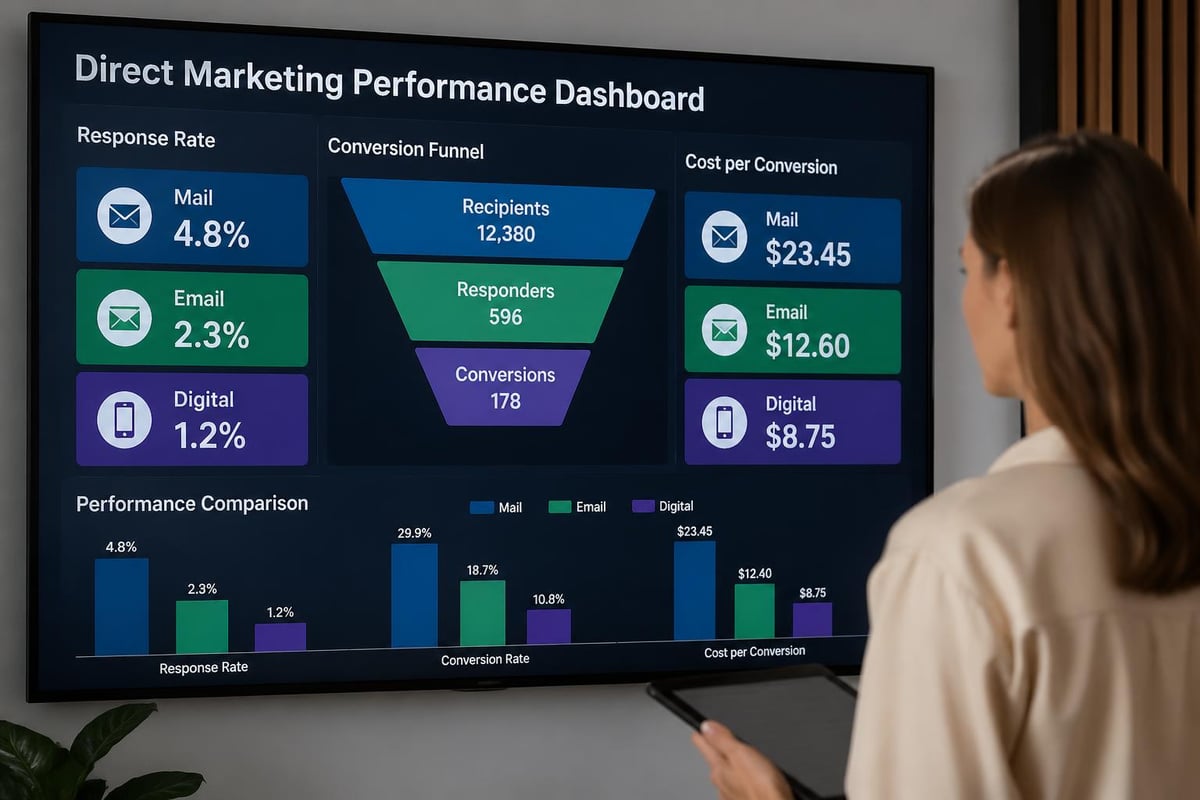
Unlike traditional advertising, direct marketing provides clear metrics that demonstrate return on investment. Financial advisors must track campaign performance to identify what works, eliminate ineffective tactics, and optimize their marketing budget allocation.
Essential Metrics to Monitor
| Metric | Calculation | Benchmark for Financial Advisors |
|---|---|---|
| Response Rate | (Responses ÷ Pieces Sent) × 100 | 0.5% – 2.0% for cold prospects |
| Cost Per Lead | Total Campaign Cost ÷ Qualified Leads | $150 – $400 depending on target market |
| Conversion Rate | (New Clients ÷ Responses) × 100 | 10% – 25% for qualified prospects |
| Client Acquisition Cost | Total Campaign Cost ÷ New Clients | $1,500 – $5,000 depending on service model |
| Lifetime Value to CAC Ratio | Average Client LTV ÷ Acquisition Cost | 5:1 or higher indicates healthy returns |
Beyond these quantitative metrics, advisors should track qualitative indicators like message clarity, brand perception, and prospect readiness. Not every campaign aims for immediate client conversion; some build awareness and trust that pays dividends over extended timeframes.
Testing different elements systematically improves results over time. Split testing allows advisors to compare two versions of a campaign, changing only one variable (subject line, offer, design, call-to-action) to determine which performs better. This iterative approach compounds improvements across multiple campaigns.
Integrating Direct Marketing with Digital Strategies
The most effective financial advisor marketing strategies combine direct marketing with digital touchpoints to create multi-channel experiences. A prospect might receive a direct mail piece, visit your website to learn more, receive follow-up emails, and see retargeting ads before scheduling a consultation.
This integrated approach recognizes that affluent prospects research financial advisors extensively before making decisions. Direct marketing initiates the relationship, while digital channels provide the depth of information prospects seek during their evaluation process.
Creating Cohesive Multi-Channel Campaigns
A comprehensive campaign might follow this sequence:
- Direct mail postcard addressing a specific financial concern with an offer to download a relevant guide
- Landing page visit where prospects provide contact information to access the resource
- Automated email sequence delivering the guide and additional educational content
- Retargeting ads appearing as prospects browse financial news sites and social media
- Follow-up phone call from the advisor's team offering a complimentary consultation
Using digital tools for financial advisors to orchestrate these touchpoints ensures consistent messaging and proper timing across channels. The seamless experience reinforces your brand and maintains engagement throughout the prospect's decision journey.
Building Your Direct Marketing Infrastructure
Successful direct marketing requires more than campaign creativity. Financial advisors need systems, processes, and technology to execute campaigns effectively at scale.
Essential infrastructure components:
- Customer relationship management (CRM) system tracking all prospect interactions and campaign responses
- Marketing automation platform managing email sequences and digital touchpoints
- Compliant content library with pre-approved messaging and templates
- Data management processes ensuring accurate contact information and segmentation
- Response handling procedures for inquiries generated by campaigns
Many advisors struggle with technology integration, but modern platforms designed specifically for financial services simplify this infrastructure. Solutions that combine CRM for financial advisors with marketing automation create a unified environment for managing direct marketing activities.
Developing Campaign Calendars
Consistency matters more than occasional bursts of activity. Financial advisors should develop annual marketing calendars mapping out direct marketing campaigns aligned with:
- Seasonal planning windows when prospects naturally think about finances (year-end, tax season, mid-year reviews)
- Life events triggering financial planning needs (retirement, inheritance, business sale)
- Market conditions creating opportunities for timely, relevant communication
- Service offerings requiring regular promotion throughout the year
A well-planned calendar balances acquisition campaigns targeting new prospects with nurture campaigns maintaining relationships with existing clients and referral sources. This dual focus supports both immediate growth and long-term sustainability.
Proven Tactics from Successful Campaigns
Financial advisors who excel at direct marketing share common approaches that consistently generate results. Studying successful direct marketing campaigns across industries reveals patterns applicable to financial services.
Top-performing tactics include:
- Offering specific, valuable resources that address immediate concerns rather than generic "free consultations"
- Using storytelling that helps prospects see themselves in client success examples
- Creating urgency through limited-time offers or capacity constraints without appearing manipulative
- Following up persistently but respectfully, recognizing that prospects need multiple touches
- Personalizing not just names but entire messaging based on prospect circumstances
One particularly effective approach involves educational seminars promoted through targeted direct mail. Advisors identify a specific topic relevant to their target market (such as "Maximizing Social Security Benefits for Federal Employees" or "Tax-Efficient Retirement Income Strategies"), secure a venue, and send personalized invitations to prospects matching that profile.
The seminar format allows advisors to demonstrate expertise, build rapport with multiple prospects simultaneously, and create natural next-step opportunities for individual consultations. Attendees self-select as interested, engaged prospects who've invested time to learn more.
Avoiding Common Direct Marketing Mistakes
Even experienced advisors make mistakes that undermine campaign effectiveness. Recognizing these pitfalls helps you allocate resources more efficiently and improve results.
Frequent errors to avoid:
- Sending too few touchpoints and abandoning campaigns before prospects respond
- Lacking clear differentiation that explains why prospects should choose you over competitors
- Focusing on features rather than benefits and outcomes prospects care about
- Ignoring response handling so inquiries generated by campaigns receive delayed or inconsistent follow-up
- Skipping testing and making assumptions about what messaging resonates
The single biggest mistake involves treating direct marketing as a one-time experiment rather than an ongoing system. Campaigns require refinement, testing, and optimization over time. Initial results rarely represent peak performance, but too many advisors abandon promising approaches after a single attempt.
According to direct mail best practices, patience combined with systematic improvement separates successful direct marketing programs from disappointing experiments. Financial advisors should commit to consistent execution for at least 12-18 months before evaluating whether direct marketing fits their practice development strategy.
Direct marketing provides financial advisors with measurable, scalable methods to reach qualified prospects and build lasting client relationships. By combining targeted audience selection, personalized messaging, multi-channel touchpoints, and systematic performance tracking, advisors create predictable client acquisition systems that complement referrals and other growth strategies. Ryan Cook specializes in creating compliant, high-converting advertising campaigns that help financial advisors connect with their ideal clients through direct marketing channels. Ready to build a systematic approach to client acquisition?