Financial advisors face unique challenges when developing ad campaigns that comply with regulations while effectively reaching high-value prospects. Unlike traditional consumer advertising, financial services marketing requires balancing compliance requirements with persuasive messaging that builds trust and credibility. Understanding how to craft campaigns that resonate with potential clients while navigating SEC and FINRA regulations separates successful advisors from those who struggle to attract qualified leads.
Understanding the Financial Advisory Advertising Landscape
The financial services industry operates under strict regulatory oversight that shapes every aspect of ad campaigns. FINRA Rule 2210 governs communications with the public, requiring pre-approval of certain materials and mandating specific disclosures. These constraints don't limit creativity but rather demand strategic thinking about messaging and channel selection.
Financial advisors must recognize that their target audience consists of individuals making high-stakes decisions about their financial futures. This context means ad campaigns must prioritize education, transparency, and credibility over flashy creative executions. Best practices for digital ad campaigns emphasize the importance of aligning creative elements with audience expectations and platform requirements.
Regulatory Compliance as a Foundation
Every ad campaign for financial advisors begins with compliance review. Your messaging must avoid:
- Performance guarantees or unrealistic return projections
- Testimonials that aren't properly documented and disclosed
- Cherry-picked data that misrepresents typical results
- Misleading comparisons to benchmarks or competitors
Working with compliance teams early in the creative process prevents costly revisions and launch delays. Document approval trails meticulously, as regulatory bodies may request justification for advertising claims years after publication.
Identifying Your Ideal Client Through Campaign Targeting
Effective ad campaigns start with precise audience definition. Financial advisors serving different market segments require distinct approaches. A wealth manager targeting high-net-worth individuals needs fundamentally different messaging than a fee-only planner serving young professionals.

Consider these critical segmentation factors:
- Asset levels: Minimum investable assets determines platform selection and creative approach
- Life stage: Pre-retirees, recent retirees, and active retirees have distinct concerns
- Geographic location: Local versus national campaigns require different compliance considerations
- Professional background: Business owners, executives, and professionals respond to specialized messaging
The digital tools for financial advisors landscape offers sophisticated targeting capabilities that align with these audience characteristics. Platforms like LinkedIn allow precise targeting by job title, industry, and company size, while Facebook enables demographic and interest-based segmentation.
Platform Selection Based on Client Behavior
Different platforms serve different purposes in your ad campaigns:
| Platform | Best For | Typical Cost | Key Advantage |
|---|---|---|---|
| High-net-worth professionals | $8-15 CPM | Professional context and precise targeting | |
| Broader demographic reach | $5-12 CPM | Detailed interest and behavior targeting | |
| Google Search | Active information seekers | $15-50 CPC | High intent, bottom-funnel prospects |
| YouTube | Educational content distribution | $6-10 CPM | Video storytelling and trust building |
Your media mix should reflect where your ideal clients spend time and how they prefer consuming information. Marketing tools for financial advisors have evolved to support multi-channel attribution, helping you understand which touchpoints contribute most to conversions.
Crafting Compliant Yet Compelling Creative
The creative elements of ad campaigns for financial advisors must balance regulatory requirements with persuasive communication. This doesn't mean boring advertisements. Instead, focus on authentic storytelling that demonstrates expertise and addresses specific client concerns.
Headline strategies that work within compliance frameworks include:
- Question-based hooks addressing specific anxieties
- Educational promises that position you as a resource
- Statistical insights that demonstrate market knowledge
- Process-oriented messaging that reduces decision uncertainty
Body copy should educate rather than persuade. Explain your planning process, describe your typical client relationships, and outline what differentiates your approach. The Adobe guide on performance-focused ad campaigns recommends defining clear goals before developing creative assets to ensure alignment between message and desired action.
Visual Elements That Build Trust
Financial services creative requires sophistication without pretension. Stock photography featuring diverse professionals in office settings has become clichéd and ineffective. Instead, consider:
- Authentic photography of your actual team and office
- Data visualizations that simplify complex concepts
- Client success stories presented as case studies (with proper disclosures)
- Educational infographics addressing common planning questions
Effective ad design principles emphasize clear calls-to-action and platform optimization. Your creative must adapt to different formats while maintaining brand consistency across touchpoints.
Developing Campaign Architecture for Lead Generation
Successful ad campaigns for financial advisors follow a structured funnel approach that nurtures prospects from awareness through conversion. This architecture typically includes three distinct campaign layers.
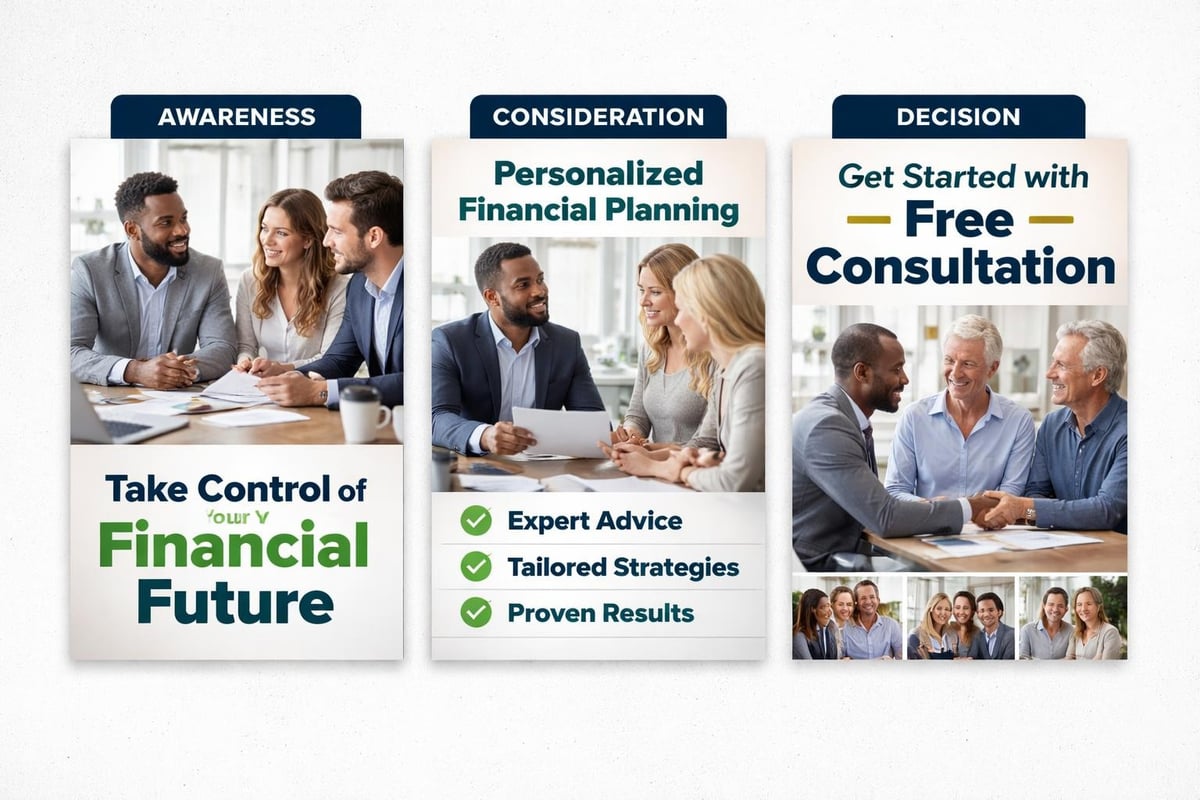
Top-of-funnel campaigns focus on broad awareness and education:
- Educational content about retirement planning strategies
- Market commentary that demonstrates expertise
- Financial planning checklists and assessment tools
- Webinar invitations on specific planning topics
These campaigns use cost-per-impression (CPM) or cost-per-view (CPV) pricing models and prioritize reach over immediate conversion. Budget allocation typically ranges from 30-40% of total campaign spend.
Middle-of-funnel campaigns engage prospects who've demonstrated initial interest:
- Retargeting to website visitors with service-specific messaging
- Lead magnet offers like planning guides or calculators
- Case study content showing your planning process
- Comparison content addressing selection criteria
These campaigns leverage cost-per-click (CPC) pricing and should represent 35-45% of your budget allocation. The goal shifts from awareness to active consideration.
Bottom-of-funnel campaigns target high-intent prospects ready for consultation:
- Direct response ads offering complimentary planning sessions
- Limited-time consultation opportunities
- Personalized assessments or portfolio reviews
- Event invitations for exclusive planning seminars
Budget Allocation and Performance Metrics
Strategic budget distribution across campaign layers maximizes return on ad spend (ROAS). Consider this allocation framework:
| Campaign Stage | Budget % | Primary Metric | Secondary Metric |
|---|---|---|---|
| Awareness | 35% | Impressions, reach | Engagement rate |
| Consideration | 40% | Click-through rate | Cost per lead |
| Decision | 25% | Conversion rate | Cost per acquisition |
Track performance against benchmarks specific to financial services advertising. Average click-through rates for financial services display ads typically range from 0.4% to 0.8%, while conversion rates from ad click to consultation request average 2% to 5%.
Leveraging Technology and Automation
Modern ad campaigns benefit enormously from marketing automation and AI tools for financial advisors. These technologies enable sophisticated personalization at scale while reducing manual campaign management burden.
Automated bidding strategies optimize your ad spend across platforms. Google's Smart Bidding and Facebook's Campaign Budget Optimization use machine learning to allocate budget toward best-performing placements and audience segments. These systems analyze thousands of signals to predict conversion likelihood and adjust bids accordingly.
Dynamic creative optimization automatically tests different combinations of headlines, images, and calls-to-action to identify top performers. Rather than manually creating dozens of ad variations, you provide creative components and let algorithms assemble optimal combinations for different audience segments.
Integration with CRM Systems
Connecting ad campaigns to your CRM for financial advisors creates closed-loop attribution tracking. This integration enables:
- Automatic lead capture from ad conversions directly into your pipeline
- Source tracking to understand which campaigns generate highest-quality prospects
- Lifecycle stage progression monitoring from first click to client conversion
- Revenue attribution connecting ad spend to actual client acquisition value
Advanced integrations support lookalike audience creation based on your best existing clients. Platforms analyze characteristics of your top-tier clients and identify prospects with similar attributes, dramatically improving targeting precision.
Testing and Optimization Strategies
Continuous optimization separates mediocre ad campaigns from exceptional ones. Financial advisors should implement structured testing protocols that generate statistically significant insights without excessive experimentation costs.
A/B testing fundamentals for financial advisor ad campaigns:
- Test one variable at a time (headline, image, call-to-action)
- Run tests until reaching statistical significance (typically 95% confidence)
- Allocate minimum 10% of budget to testing new approaches
- Document learnings systematically for institutional knowledge building
Creative best practices emphasize A/B testing as essential for refining messaging over time. What resonates with your specific audience may differ from industry averages or competitor approaches.

Performance Analysis Frameworks
Regular performance reviews should examine both quantitative metrics and qualitative indicators:
Quantitative analysis includes:
- Cost per lead trending over time
- Conversion rate by campaign, ad set, and individual creative
- Return on ad spend calculated using lifetime client value
- Attribution modeling showing multi-touch conversion paths
- Audience segment performance comparisons
Qualitative assessment considers:
- Lead quality ratings from your intake process
- Consultation show rates and conversion to client
- Client feedback on how they discovered your services
- Competitive positioning relative to other advisor marketing
The successful digital marketing campaign case studies reveal common patterns among top performers: consistent testing, rapid iteration based on data, and alignment between ad messaging and actual service delivery.
Compliance Documentation and Recordkeeping
Ad campaigns for financial advisors require meticulous documentation to satisfy regulatory requirements. FINRA mandates retention of advertising materials and related records for specified periods, typically three to six years depending on content type.
Establish systematic processes for:
- Pre-approval workflows with compliance review checkpoints
- Version control for all creative assets and copy variations
- Performance data archiving that correlates with specific ad versions
- Disclosure tracking ensuring required statements appear correctly
- Platform screenshot capture documenting actual ad presentation
Many advisors use specialized compliance software that integrates with advertising platforms to automate documentation. These systems capture ad creative, targeting parameters, and performance data in tamper-proof archives that simplify regulatory audits.
Managing Third-Party Content and Endorsements
When ad campaigns reference third-party research, rankings, or endorsements, additional documentation becomes critical. You must maintain:
- Original source materials for any cited statistics or research
- Licensing agreements for third-party content usage
- Documentation of compensation arrangements for any endorsers
- Records showing endorser status as actual clients (when applicable)
- Proof of proper disclosure presentation in all ad variations
Understanding how to leverage tools effectively includes knowing which solutions support compliance workflows specific to financial services advertising.
Coordinating Ad Campaigns with Content Marketing
The most effective ad campaigns don't operate in isolation but rather support integrated content marketing strategies. Your paid advertising should drive prospects to high-quality educational content that demonstrates expertise and builds trust over time.
Content destinations for ad traffic include:
- Educational blog posts addressing specific planning questions
- Video content explaining complex financial concepts simply
- Interactive calculators and assessment tools
- Webinar registration pages for live educational events
- Email newsletter signup flows delivering ongoing value
This approach transforms ad campaigns from pure direct response vehicles into relationship-building tools. Prospects who initially discover you through paid ads but aren't ready for immediate consultation can enter nurture sequences that maintain engagement until they reach decision readiness.
Retargeting campaigns can then re-engage content consumers with increasingly specific messaging based on their demonstrated interests. Someone who downloaded your retirement planning guide receives different ad creative than someone who used your Social Security optimization calculator.
Measuring Long-Term Campaign Impact
Financial advisor client acquisition cycles often span months from initial awareness to signed agreement. This extended timeline requires measurement frameworks that capture long-term campaign value rather than immediate conversions alone.
Implement multi-touch attribution models that assign value to each campaign touchpoint in the client journey. Common approaches include:
| Model Type | Value Distribution | Best Used When |
|---|---|---|
| First-touch | 100% to initial ad | Understanding awareness sources |
| Last-touch | 100% to final ad before conversion | Evaluating closing effectiveness |
| Linear | Equal credit to all touchpoints | Assessing full journey |
| Time-decay | More credit to recent interactions | Emphasizing decision-stage impact |
| Position-based | 40% first, 40% last, 20% middle | Balancing awareness and conversion |
Track lifetime client value against acquisition cost to evaluate true campaign ROI. A client generating $50,000 in annual revenue over a ten-year relationship justifies significantly higher acquisition costs than short-term transactional metrics might suggest.
Many financial advisors find that optimizing their entire RIA tech stack enables more sophisticated measurement by connecting advertising data with client relationship management, portfolio management, and billing systems for comprehensive performance visibility.
Creating effective ad campaigns for financial advisors requires balancing regulatory compliance with persuasive marketing that builds trust and demonstrates expertise. Success depends on precise targeting, compliant creative development, systematic testing, and long-term performance measurement. If you're ready to develop ad campaigns that attract qualified prospects while meeting all compliance requirements, Ryan Cook specializes in ad services and creation specifically designed for financial advisors, helping you navigate the unique challenges of marketing in this highly regulated industry.