
Marketing consulting has evolved into a critical investment for financial advisory firms seeking to differentiate themselves in an increasingly competitive marketplace. As the industry shifts toward digital-first client acquisition and relationship management, financial advisors are turning to specialized consultants who understand both marketing fundamentals and the unique regulatory environment of wealth management. This strategic partnership enables firms to build sustainable growth engines while maintaining compliance and building authentic client relationships that stand the test of time.
The Strategic Value of Marketing Consulting for Financial Services
The financial advisory space presents unique challenges that generic marketing approaches simply cannot address effectively. Marketing consulting provides financial advisors with industry-specific expertise that bridges the gap between traditional wealth management practices and modern digital marketing requirements.
Specialized consultants bring several critical advantages to financial advisory firms:
- Deep understanding of SEC and FINRA regulations governing client communications
- Experience navigating testimonial restrictions and advertising compliance requirements
- Knowledge of affluent client psychology and decision-making patterns
- Proven frameworks for measuring marketing ROI in long sales cycle environments
According to comprehensive marketing consulting statistics, the industry has grown substantially, with demand increasing 23% year-over-year as businesses recognize the complexity of modern marketing ecosystems. Financial advisors particularly benefit from this specialized knowledge because the consequences of non-compliant marketing can be severe.
Building a Foundation for Sustainable Growth
Marketing consulting goes beyond tactical campaign execution. The best consultants work with financial advisors to establish foundational elements that support long-term business development. This includes defining ideal client profiles, articulating unique value propositions, and creating positioning strategies that resonate with specific market segments.
A well-structured consulting engagement typically begins with a comprehensive audit of existing marketing efforts, competitive landscape analysis, and identification of untapped opportunities. This diagnostic phase reveals gaps between current performance and potential outcomes, providing a roadmap for strategic improvement.

Pricing Models and Investment Considerations
Understanding how marketing consulting is structured financially helps financial advisors make informed decisions about engaging external expertise. The investment in consulting should align with expected outcomes and business growth objectives.
| Pricing Model | Typical Range | Best For | Considerations |
|---|---|---|---|
| Hourly Consulting | $150-$500/hour | Specific project needs, tactical advice | Variable costs, harder to budget |
| Monthly Retainer | $3,000-$15,000/month | Ongoing strategic support | Predictable investment, relationship depth |
| Project-Based | $5,000-$50,000+ | Defined deliverables, website launches | Clear scope, one-time investment |
| Performance-Based | Variable + % revenue | Aggressive growth goals | Aligned incentives, higher complexity |
The marketing consulting market growth projections indicate subscription-based models are gaining traction, offering predictable costs and sustained support relationships.
Evaluating ROI in Consulting Engagements
Financial advisors should approach marketing consulting with the same analytical rigor they apply to investment decisions. Establishing clear key performance indicators (KPIs) before engagement ensures accountability and measurable progress.
Critical metrics for measuring consulting effectiveness include:
- Client acquisition cost (CAC) trends over time
- Qualified lead volume and conversion rates
- Assets under management (AUM) growth attributed to marketing initiatives
- Brand awareness metrics within target demographics
- Digital presence indicators such as website traffic and engagement
Smart financial advisors build marketing tools into their technology stack that enable precise tracking of these metrics, creating transparency around consulting impact.
Digital Transformation and Marketing Consulting
The digital transformation impact on consulting markets has fundamentally changed how marketing consultants approach client engagements. Financial advisors must navigate an increasingly complex digital ecosystem while maintaining the personal touch that defines successful wealth management relationships.
Marketing consulting now encompasses expertise in content marketing, search engine optimization, social media strategy, email automation, and paid digital advertising. Each channel requires specialized knowledge, and the integration between channels often determines overall campaign effectiveness.
Content Strategy Development
Financial advisors possess tremendous knowledge but often struggle to package that expertise into compelling content that attracts ideal clients. Marketing consulting helps translate technical financial planning concepts into accessible, valuable content that demonstrates thought leadership.
A robust content strategy includes:
- Audience research and persona development to understand target client information needs
- Content pillar identification focusing on topics where the advisor has unique expertise
- Multi-format content creation spanning written articles, video content, podcasts, and infographics
- Distribution optimization ensuring content reaches the right audiences through appropriate channels
- Performance analysis measuring engagement and adjusting strategy based on data
Consultants help advisors develop systematic content production processes that maintain consistency without overwhelming internal resources. This might include identifying prospecting tools that streamline outreach or implementing automation for content distribution.

Specialized Advertising Strategies for Financial Advisors
Advertising represents one of the most complex aspects of marketing consulting for financial services. The regulatory environment requires careful navigation, and the high client lifetime value demands sophisticated targeting and conversion optimization.
Marketing consulting for advertising encompasses strategy development, creative production, platform selection, campaign management, and continuous optimization. Financial advisors benefit from consultants who understand both the marketing technology and the compliance requirements governing financial services advertising.
Compliance-Conscious Campaign Development
Every advertising element requires careful review to ensure regulatory compliance. Marketing consultants experienced in financial services understand the nuances of creating compelling advertisements that satisfy regulatory requirements.
Key compliance considerations include:
- Avoiding promissory language or guaranteed returns
- Including appropriate risk disclosures and disclaimers
- Maintaining records of all advertising materials for regulatory review
- Implementing approval workflows before campaign launches
- Understanding platform-specific requirements for financial services ads
The consulting industry trends show increasing integration of AI and automation tools, but human oversight remains essential for compliance-sensitive industries like financial services.
Platform Selection and Optimization
Different advertising platforms offer varying advantages for financial advisors. Marketing consulting helps identify the optimal channel mix based on target client demographics, budget constraints, and business development objectives.
| Platform | Strengths for Advisors | Typical CPC | Conversion Characteristics |
|---|---|---|---|
| Google Search | High intent targeting | $3-$12 | Longer consideration, higher quality |
| Professional targeting | $5-$15 | B2B focus, corporate retirement plans | |
| Facebook/Instagram | Demographic precision | $1-$5 | Broader reach, nurture required |
| YouTube | Educational content | $0.10-$0.30 (CPV) | Authority building, longer engagement |
Consultants help financial advisors understand that digital tools extend beyond advertising platforms to include CRM systems, marketing automation, and analytics platforms that work together to create a comprehensive marketing ecosystem.
Strategic Planning and Implementation Frameworks
Marketing consulting delivers maximum value when consultants work collaboratively with financial advisory teams to develop customized implementation frameworks. Generic templates rarely account for the specific circumstances, competitive positioning, and growth objectives of individual firms.
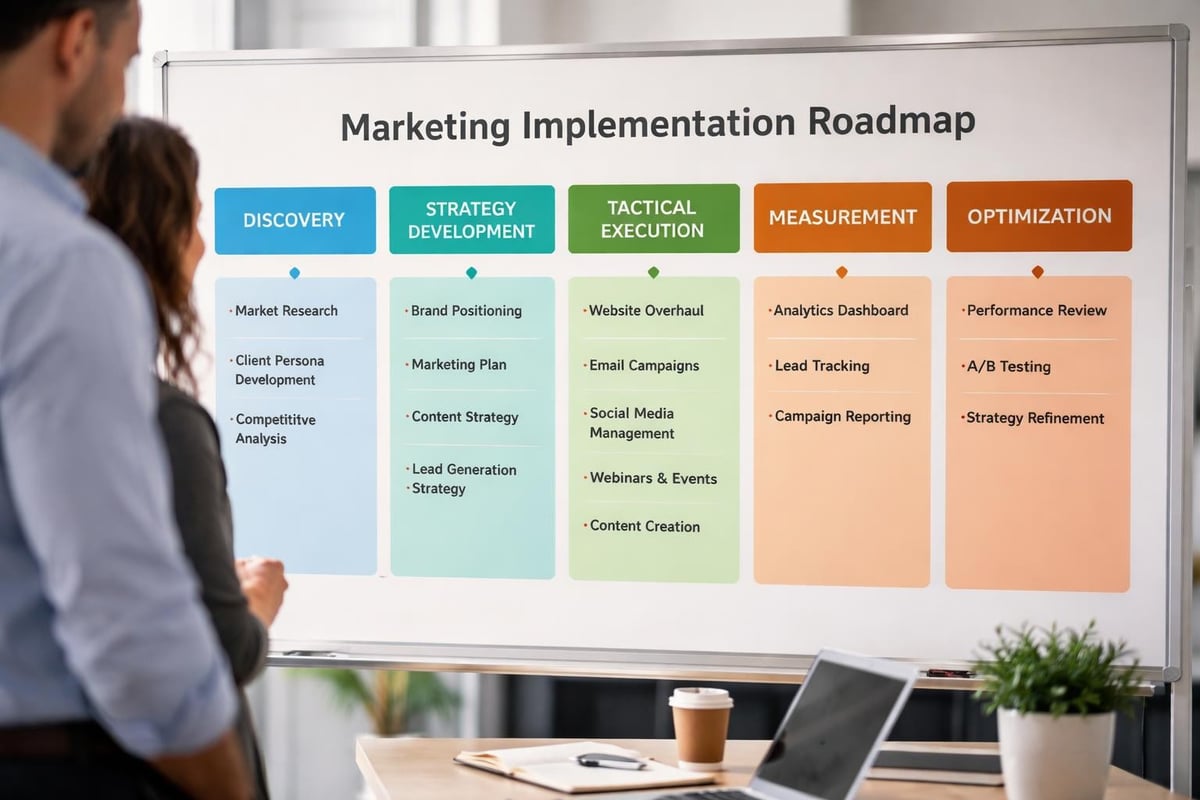
The strategic planning process typically unfolds across several phases, each building upon previous work to create a comprehensive marketing blueprint.
Discovery and Assessment Phase
Effective marketing consulting begins with thorough understanding of the advisory firm's current state, including existing client relationships, service offerings, competitive advantages, and growth aspirations. This discovery process might include stakeholder interviews, client surveys, competitive analysis, and marketing asset audits.
Consultants examine everything from the firm's website user experience to its social media presence, email marketing effectiveness, and referral generation systems. This comprehensive view identifies both quick wins and longer-term strategic opportunities.
Strategy Architecture Development
Based on discovery insights, marketing consultants architect a strategic framework that aligns marketing investments with business objectives. This includes defining target market segments, positioning strategies, messaging frameworks, and channel priorities.
A complete strategy architecture addresses:
- Brand positioning and differentiation in the local or niche market
- Client journey mapping from awareness through onboarding
- Content strategy aligned with prospect information needs
- Lead generation and nurturing systems
- Measurement frameworks and success metrics
Consultants often help financial advisors implement CRM solutions that enable systematic relationship management and marketing attribution.
Technology Integration and Marketing Operations
Modern marketing consulting increasingly involves technology selection, integration, and optimization. The global marketing consulting market analysis highlights AI integration and digital marketing technology as key growth drivers, with consultants playing crucial roles in helping businesses navigate complex technology landscapes.
Financial advisors need marketing technology stacks that balance functionality, usability, compliance, and integration capabilities. Marketing consultants help evaluate options and implement systems that enhance rather than complicate marketing operations.
Building Integrated Marketing Systems
Disconnected marketing tools create data silos and operational inefficiencies. Marketing consulting helps financial advisors build integrated systems where client relationship management, email marketing, content management, and analytics platforms share data seamlessly.
This integration enables sophisticated marketing automation workflows that nurture prospects systematically while maintaining the personal touch financial advisors require. For example, prospects who download a retirement planning guide might automatically receive a series of educational emails over subsequent weeks, with advisors receiving notifications when prospects demonstrate high engagement.
The right technology foundation also supports AI tools for financial advisors that can enhance productivity without replacing the essential human elements of wealth management relationships.
Measuring Success and Continuous Improvement
Marketing consulting should establish clear measurement frameworks that track progress toward defined objectives. Financial advisors need visibility into which marketing investments generate returns and which require adjustment or elimination.
Establishing Marketing Dashboards
Comprehensive marketing dashboards provide real-time visibility into campaign performance, lead generation metrics, and business development outcomes. Marketing consultants help design dashboards that balance detail with usability, ensuring advisors can quickly assess marketing effectiveness.
Essential dashboard elements include:
- Lead generation volume and quality trends
- Cost per lead and cost per client acquisition
- Website traffic sources and conversion rates
- Content engagement metrics and top-performing assets
- Email marketing open rates, click-through rates, and conversions
- Social media reach, engagement, and referral traffic
- Advertising campaign performance across platforms
Regular dashboard review with marketing consultants enables data-driven decision-making and rapid response to emerging opportunities or underperforming initiatives.
Optimization Cycles and Testing Frameworks
Marketing consulting includes ongoing optimization that continuously improves campaign performance. This involves systematic testing of messaging variations, audience targeting parameters, creative elements, and conversion pathways.
Financial advisors working with consultants should expect regular performance reviews that identify optimization opportunities. These might include A/B testing different email subject lines, experimenting with various ad creative approaches, or adjusting targeting parameters based on conversion data.
The industry statistics and trends show that firms investing in continuous optimization achieve significantly better returns than those treating marketing as a set-and-forget activity.
Selecting the Right Marketing Consulting Partner
The decision to engage marketing consulting represents a significant investment, and partner selection dramatically impacts outcomes. Financial advisors should approach consultant selection with the same diligence they apply to other critical business decisions.
Evaluation Criteria for Consulting Partners
When evaluating potential marketing consultants, financial advisors should consider:
- Industry experience: Specific knowledge of financial services marketing and compliance requirements
- Results documentation: Case studies and references from similar advisory firms
- Strategic vs. tactical focus: Balance between big-picture strategy and hands-on implementation
- Communication style: Compatibility with internal team dynamics and decision-making processes
- Technology expertise: Familiarity with marketing platforms relevant to financial services
- Pricing transparency: Clear scope definitions and investment expectations
Many financial advisors benefit from consultants who combine strategic marketing expertise with understanding of the RIA tech stack ecosystem, ensuring marketing recommendations integrate smoothly with existing operational systems.
Engagement Models and Partnership Structures
Marketing consulting relationships can be structured various ways depending on firm needs and growth stage. Some advisors prefer project-based engagements for specific initiatives like website redesigns or campaign launches. Others benefit from ongoing retainer relationships that provide continuous strategic support.
Hybrid models increasingly popular in 2026 combine baseline retainer services with project-based add-ons for specific initiatives. This approach provides strategic continuity while maintaining flexibility for opportunistic investments in high-potential campaigns.
Emerging Trends Shaping Marketing Consulting
The marketing consulting landscape continues evolving rapidly, driven by technological innovation, changing consumer behaviors, and regulatory developments. Financial advisors working with consultants should understand these trends to make informed decisions about marketing investments.
Artificial intelligence has transformed many aspects of marketing consulting, from audience research to content optimization and campaign management. However, the tech consulting market projections emphasize that technology complements rather than replaces strategic human expertise.
Privacy-First Marketing Approaches
Regulatory changes affecting data privacy have fundamentally altered digital marketing practices. Marketing consultants help financial advisors navigate these changes while maintaining effective audience targeting and campaign measurement.
This includes implementing first-party data collection strategies, adjusting to cookie deprecation, and building marketing approaches based on value exchange rather than surveillance. Financial advisors benefit from consultants who understand both the technical implications and strategic opportunities these privacy changes create.
Video and Interactive Content Dominance
Video content has become essential for financial advisors seeking to build trust and demonstrate expertise. Marketing consulting increasingly includes video strategy development, production support, and distribution optimization across platforms like YouTube, LinkedIn, and advisor websites.
Interactive content tools like calculators, assessments, and planning resources also generate high engagement while providing valuable prospect information. Consultants help advisors identify appropriate interactive content opportunities and implement tools that enhance rather than complicate user experiences.
Marketing consulting provides financial advisors with specialized expertise that accelerates growth while navigating the unique challenges of financial services marketing. The combination of strategic planning, tactical execution support, and continuous optimization creates sustainable competitive advantages in increasingly crowded markets. When you're ready to transform your marketing approach and build systematic client acquisition processes, Ryan Cook specializes in advertising services and ad creation designed specifically for financial advisors, helping you attract ideal clients while maintaining compliance and authenticity.