The financial advisory industry faces unprecedented competition for client attention in 2026. Traditional marketing approaches no longer deliver the returns they once did, forcing advisors to seek innovative solutions that can cut through the noise. Marketing with AI has emerged as the definitive answer, enabling financial professionals to create highly targeted campaigns, personalize messaging at scale, and optimize ad spend with precision previously impossible through manual methods. This technological shift isn't just about automation; it's about fundamentally reimagining how financial advisors connect with prospects and convert them into long-term clients.
Understanding the AI Marketing Revolution for Financial Advisors
Marketing with AI represents a paradigm shift in how financial advisors approach client acquisition. Unlike conventional marketing methods that rely heavily on intuition and broad demographic targeting, AI-powered systems analyze vast datasets to identify patterns invisible to human marketers.
The technology leverages multiple capabilities simultaneously:
- Predictive analytics that forecast which prospects are most likely to convert
- Natural language processing that crafts personalized messaging for different audience segments
- Machine learning algorithms that continuously optimize ad performance based on real-time data
- Computer vision that identifies which visual elements resonate with specific demographics
Financial advisors who have adopted AI marketing strategies report significant improvements in key performance indicators. Campaign response rates often double or triple compared to traditional approaches, while cost-per-acquisition typically drops by 30-50%. These aren't incremental improvements; they represent fundamental efficiency gains that directly impact profitability.

The Data Advantage in Financial Services Marketing
The financial advisory sector generates enormous amounts of client interaction data. Every website visit, email open, form submission, and content download provides valuable signals about prospect intent and readiness to engage. Marketing with AI transforms this raw data into actionable intelligence.
Traditional marketing teams might segment audiences into three or four broad categories based on age and income. AI systems can identify dozens of micro-segments, each with distinct preferences, pain points, and decision-making patterns. A prospect researching retirement planning at 2 AM exhibits different characteristics than one exploring estate planning during business hours. AI recognizes these nuances and adjusts messaging accordingly.
Implementing AI-Powered Ad Creation for Maximum Impact
Creating effective advertisements for financial services requires balancing compliance requirements with compelling messaging. This challenge becomes exponentially more complex when attempting to personalize at scale. Marketing with AI solves this problem by maintaining brand consistency and regulatory compliance while customizing individual ad elements.
Dynamic Creative Optimization
Modern AI platforms can generate hundreds of ad variations from a single creative brief. The system tests different headlines, images, calls-to-action, and body copy combinations, identifying which elements perform best for specific audience segments.
Key elements that AI optimizes include:
- Headline formulations that emphasize different value propositions
- Visual compositions that highlight relevant financial scenarios
- Call-to-action buttons positioned for maximum conversion
- Ad copy length adjusted based on platform and device type
- Compliance language integrated seamlessly without disrupting flow
Financial advisors using tools designed for small businesses can compete effectively against larger firms with bigger marketing budgets. The AI levels the playing field by ensuring every dollar spent generates maximum return.
Audience Targeting Precision
Traditional demographic targeting reaches broad swaths of potentially interested prospects. Marketing with AI narrows focus to individuals exhibiting specific behavioral signals that indicate readiness to engage with a financial advisor.
| Traditional Targeting | AI-Powered Targeting |
|---|---|
| Age 45-65, Income $150K+ | Exhibited retirement planning research, opened estate planning emails, visited fee calculator page |
| Small business owners | Downloaded business succession guide, engaged with tax strategy content, scheduled initial consultation |
| Recent retirees | Searched 401k rollover information, compared annuity options, viewed client testimonials |
The precision extends beyond initial targeting. AI continuously monitors prospect engagement, adjusting bid strategies and creative deployment based on likelihood to convert. Someone who watched 90% of an educational video receives different follow-up messaging than someone who clicked away after 10 seconds.
Scaling Personalization Without Sacrificing Quality
Financial advisors understand that trust drives client relationships. Prospects need to feel understood, not marketed to. Marketing with AI enables personalization at a scale impossible through manual methods while maintaining the authentic, consultative tone essential in financial services.
Content Customization Based on Journey Stage
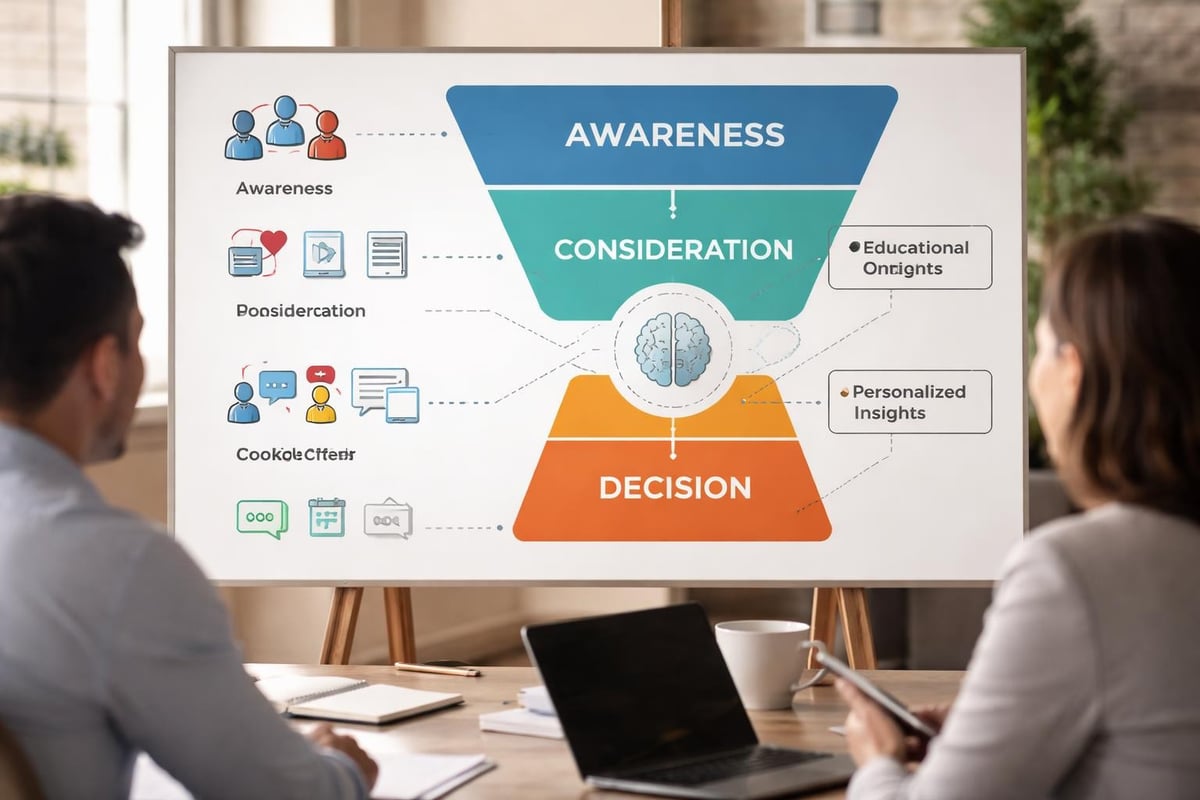
Every prospect exists at a different point in their decision-making journey. Some are just beginning to explore whether they need a financial advisor. Others are actively comparing specific professionals. AI recognizes these distinctions and delivers appropriate content for each stage.
Early-stage prospects receive:
- Educational content explaining financial planning fundamentals
- Thought leadership establishing advisor expertise
- Low-commitment offers like guides or webinars
- Gentle nurturing sequences building familiarity over time
Late-stage prospects receive:
- Direct comparison information highlighting unique value propositions
- Client success stories demonstrating measurable results
- Clear calls-to-action for consultations or discovery calls
- Urgency-driven messaging encouraging immediate engagement
This journey-based approach, powered by marketing with AI, converts significantly better than one-size-fits-all campaigns. Understanding how to leverage AI tools specifically for financial advisory practices ensures compliance while maximizing effectiveness.
Real-Time Campaign Adjustments
Markets change rapidly. A news event affecting retirement accounts can shift prospect concerns overnight. Marketing with AI adapts instantly, adjusting messaging to address current anxieties and opportunities without requiring manual intervention.
The systems monitor hundreds of signals simultaneously:
- Market volatility indices affecting investor confidence
- Trending financial topics in news and social media
- Seasonal patterns in financial planning inquiries
- Competitive advertising activity and positioning shifts
- Regulatory changes impacting messaging requirements
When patterns emerge, the AI automatically tests messaging variations addressing new concerns. If market volatility spikes, ads might emphasize portfolio protection strategies. During tax season, messaging could shift toward tax-advantaged investment opportunities. This responsiveness keeps campaigns relevant without constant manual oversight.
Measuring ROI with AI-Enhanced Analytics
Traditional marketing analytics tell you what happened. Marketing with AI tells you why it happened and what to do next. This predictive capability transforms campaign management from reactive adjustment to proactive optimization.
Attribution Modeling Beyond Last Click
Financial advisory sales cycles often span months. Prospects typically interact with multiple touchpoints before scheduling a consultation. Standard analytics credit the final interaction, ignoring all the nurturing that preceded it. AI attribution models recognize the full journey.
A prospect might first see a social media ad, later click a retargeting display ad, download an email guide, watch a webinar, and finally schedule a call. Each touchpoint contributed to the conversion. Marketing with AI assigns appropriate value to each interaction, revealing which channels and messages actually drive results.
Advanced attribution reveals:
- Which initial touchpoints most effectively start prospect relationships
- What content formats maintain engagement during consideration phases
- Which retargeting strategies effectively re-engage dormant prospects
- What final triggers convert educated prospects into scheduled consultations
- How different prospect segments respond to varied marketing approaches
This granular understanding allows financial advisors to allocate budgets more effectively, investing heavily in tactics that genuinely drive conversions while reducing spend on activities that simply look good in surface-level reports.
Predictive Performance Forecasting
Budgeting for marketing becomes considerably easier when you can accurately forecast returns. Marketing with AI analyzes historical performance data, seasonal patterns, market conditions, and competitive factors to predict future campaign outcomes with remarkable accuracy.
Planning a Q3 campaign targeting pre-retirees? The AI can estimate expected impressions, click-through rates, lead generation volume, and consultation bookings based on similar historical campaigns adjusted for current market conditions. These forecasts enable confident budget allocation and realistic goal setting.
Integrating AI Marketing with Existing Systems
Financial advisors already use various technology platforms for client management, compliance, and operations. Marketing with AI works best when integrated seamlessly with these existing systems, creating a unified technology ecosystem.
CRM Integration for Closed-Loop Reporting
The most powerful insights emerge when marketing data connects with CRM systems tracking actual client conversions and lifetime value. This integration reveals which marketing channels and messages attract not just any leads, but specifically the prospects who become long-term, high-value clients.
| Marketing Source | Leads Generated | Consultations Booked | Clients Acquired | Average AUM | Lifetime Value |
|---|---|---|---|---|---|
| AI-Optimized LinkedIn | 45 | 23 | 8 | $840K | $168K |
| Traditional Print Ads | 78 | 12 | 3 | $420K | $84K |
| AI-Powered Search Ads | 156 | 67 | 19 | $675K | $135K |
This data transforms budget allocation decisions. Even though traditional print ads generated more initial leads, the quality and conversion rate lag significantly behind AI-optimized digital channels. Understanding how various marketing tools integrate with comprehensive business systems ensures maximum efficiency.
Compliance and Oversight Mechanisms
Financial services marketing faces strict regulatory requirements. Marketing with AI doesn't eliminate compliance obligations; it makes maintaining compliance far more manageable. AI systems can be programmed with regulatory guardrails that prevent non-compliant messaging from ever reaching prospects.
Compliance features include:
- Automated review of all ad copy against regulatory databases
- Required disclosure insertion in appropriate contexts
- Prohibited claim detection and flagging
- Approval workflow routing for human oversight
- Audit trail maintenance for regulatory documentation
Recent developments in AI marketing frameworks emphasize building trust rather than simply generating clicks, aligning perfectly with the ethical imperatives of financial advisory marketing.
Advanced Strategies for Competitive Advantage
Basic implementation of marketing with AI delivers immediate improvements. Advanced strategies create sustainable competitive advantages that compound over time.

Competitive Intelligence and Positioning
AI tools monitor competitor advertising activity, identifying messaging themes, targeting strategies, and promotional offers. This intelligence informs differentiation strategies, ensuring your marketing emphasizes unique value propositions that competitors aren't addressing.
If competitors heavily emphasize low fees, AI might recommend positioning around comprehensive planning or specialized expertise. When everyone in your market targets retirees, the system might identify underserved segments like business owners or healthcare professionals exhibiting strong financial planning signals.
Multi-Channel Orchestration
Prospects don't live on a single platform. They browse social media, search Google, read emails, and watch streaming content. Marketing with AI coordinates messaging across all these channels, ensuring consistent, complementary experiences regardless of where prospects encounter your brand.
Someone who watched 75% of a Facebook video about retirement planning might see a LinkedIn ad addressing common retirement concerns with a link to download a comprehensive guide. After downloading the guide, they receive a personalized email sequence addressing topics they showed interest in based on which guide sections they spent the most time reading.
This orchestration feels natural to prospects while requiring minimal manual coordination. The AI handles the complex timing, frequency capping, and message sequencing that would overwhelm a human marketing team.
Campaign Scaling and Efficiency
Traditional marketing requires proportional increases in team size to scale campaign volume. Marketing with AI breaks this relationship. The same system managing ten campaigns can manage a hundred with minimal additional overhead.
For financial advisors looking to expand into new geographic markets or service offerings, this scalability proves invaluable. Launch campaigns targeting five new metropolitan areas simultaneously, each with localized messaging and geographic-specific regulations, without quintupling your marketing team. Advanced AI capabilities now enable complete campaign management across multiple channels from a single platform.
Overcoming Common Implementation Challenges
Despite clear benefits, financial advisors sometimes hesitate to adopt marketing with AI due to perceived complexity or concerns about losing personal touch. Understanding these challenges and their solutions accelerates successful implementation.
The Learning Curve Reality
Modern AI marketing platforms emphasize user-friendly interfaces specifically designed for professionals without technical backgrounds. You don't need to understand machine learning algorithms to benefit from them, just as you don't need to understand internal combustion engines to drive a car effectively.
Implementation typically follows this progression:
- Initial platform setup and integration (typically 1-2 weeks)
- Campaign template creation and compliance review (1 week)
- First campaign launch with AI optimization enabled (ongoing)
- Performance monitoring and strategic refinement (monthly)
- Advanced feature adoption as comfort grows (quarterly)
Most financial advisors see measurable improvements within the first month, with results compounding as the AI learns from accumulating data.
Maintaining Authentic Voice
Some advisors worry that marketing with AI produces generic, robotic messaging that damages their personal brand. Quality platforms allow extensive customization, learning your specific tone, preferred terminology, and brand personality. The AI amplifies your voice; it doesn't replace it.
You provide the strategic direction, value propositions, and brand guidelines. The AI handles the tactical execution, personalization, and optimization. This collaboration produces better results than either humans or machines could achieve independently.
Budget Considerations and ROI Timeline
Marketing with AI requires investment in platform fees and potentially higher initial ad spend to generate sufficient data for optimization. However, evidence from agencies deploying thousands of AI campaigns demonstrates that efficiency gains typically offset these costs within three to six months.
Consider the total cost of client acquisition, not just platform fees. If AI reduces your cost-per-client from $3,000 to $1,500 while improving client quality, the ROI justifies significant platform investment.
Future-Proofing Your Marketing Approach
The pace of AI advancement shows no signs of slowing. Financial advisors who establish marketing with AI capabilities now position themselves advantageously for coming innovations.
Voice and Conversational AI Integration
Voice search and smart speaker usage continue growing. Future AI marketing systems will optimize for voice queries, understanding the different phrasing people use when speaking versus typing. "Hey Google, find me a retirement planner in Austin" requires different optimization than typed searches.
Conversational AI will handle initial prospect interactions, answering common questions, qualifying interest level, and scheduling consultations only with genuinely interested, qualified prospects. This automation handles routine tasks while freeing advisors for high-value personal interactions.
Predictive Prospect Identification
Emerging AI capabilities identify prospects before they actively search for financial advisors. By analyzing patterns in financial behavior, life events, and digital footprints, systems predict who will likely need advisory services in the next 3-6 months. Reaching these prospects before competition does provides enormous advantages.
Hyper-Personalization at Scale
Current personalization adjusts messaging based on demographics and behavior. Next-generation marketing with AI will create truly individualized campaigns, with unique creative, offers, and engagement strategies for each prospect based on their specific situation, preferences, and decision-making style.
Imagine campaigns where every prospect receives effectively bespoke marketing experiences, as if you had a dedicated marketing team focused solely on them. This level of personalization becomes possible only through AI systems managing complexity beyond human capability.
Building the Right Foundation
Success with marketing with AI requires more than just platform selection. Financial advisors need strategic foundations ensuring technology serves business objectives rather than complicating operations.
Clear Objective Definition
What specifically do you want to achieve? More consultations booked? Higher-quality prospects? Expansion into new market segments? Improved client retention? Different objectives require different AI configurations and optimization targets.
Common objectives include:
- Reducing cost-per-consultation by 40%
- Increasing qualified lead volume by 75%
- Improving consultation-to-client conversion by 25%
- Shortening sales cycle duration by 30 days
- Expanding into three new geographic markets
Precise objectives enable precise AI optimization. Vague goals produce mediocre results regardless of technological sophistication.
Data Quality and Quantity
AI systems improve with more data, but quality matters as much as quantity. Clean, accurate tracking of prospect interactions, conversion events, and campaign performance feeds better AI decision-making. Investing in proper analytics implementation pays dividends throughout your marketing with AI journey.
Ensure your systems capture not just what marketing activities occurred, but actual business outcomes. Did that prospect become a client? What's their lifetime value? Which marketing touchpoints influenced their decision? Comprehensive business systems that integrate marketing, sales, and client management provide the data foundation AI needs for maximum effectiveness.
Marketing with AI fundamentally transforms how financial advisors attract and convert clients, delivering measurable improvements in efficiency, personalization, and ROI. The technology handles complex optimization and personalization tasks at scale while maintaining the authentic, consultative approach essential in financial services. Ryan Cook specializes in creating AI-powered advertising campaigns specifically designed for financial advisors, combining cutting-edge technology with deep industry expertise to maximize your marketing performance. Discover how our ad creation services can transform your client acquisition strategy and drive sustainable practice growth.