
The financial advisory industry faces unique marketing challenges in 2026. Building trust, demonstrating expertise, and connecting with high-value clients requires precision that traditional advertising methods struggle to deliver. AI for marketing campaigns has emerged as the solution that bridges this gap, offering financial advisors unprecedented capabilities to create, optimize, and scale their advertising efforts. This technology transforms how advisors identify prospects, craft messaging, and measure campaign performance across multiple channels.
Understanding AI's Role in Modern Marketing Campaigns
AI for marketing campaigns represents a fundamental shift in how financial advisors approach client acquisition. Rather than relying on broad demographic targeting and generic messaging, artificial intelligence analyzes thousands of data points to identify patterns invisible to human marketers.
Data-Driven Audience Identification
Financial advisors traditionally segment audiences by age, income, and location. AI technology goes deeper, analyzing behavioral signals, digital engagement patterns, and predictive indicators of financial need. This granular understanding enables campaign creation that speaks directly to specific pain points.
The technology processes information from multiple sources simultaneously:
- Website visitor behavior and page engagement duration
- Social media interaction patterns and content preferences
- Email open rates and click-through behaviors
- Market conditions affecting target demographics
- Competitive landscape analysis
Machine learning algorithms identify which prospects show readiness for financial advisory services based on digital footprints. This capability proves particularly valuable for advisors targeting pre-retirees, business owners, or sudden wealth recipients.

Personalization at Scale
Creating personalized messages for hundreds or thousands of prospects would require impossible amounts of human time. AI for marketing campaigns solves this challenge by generating customized ad variations that maintain your brand voice while addressing individual prospect concerns.
| Traditional Approach | AI-Powered Approach |
|---|---|
| 3-5 ad variations per campaign | Hundreds of personalized variations |
| Manual A/B testing over weeks | Continuous real-time optimization |
| Demographic-based targeting | Behavioral and intent-based targeting |
| Monthly performance reviews | Instant performance adjustments |
Financial advisors using AI marketing tools report significant improvements in engagement rates and cost per acquisition. The technology adapts messaging based on how different segments respond, continuously refining approach.
Strategic Implementation for Financial Advisor Campaigns
Implementing AI for marketing campaigns requires strategic planning rather than simply activating new software. Financial advisors must align AI capabilities with business development goals and compliance requirements.
Campaign Objective Alignment
Define clear outcomes before deployment. AI excels at optimization but requires specific targets. Financial advisors typically pursue objectives like:
- Increasing qualified consultation bookings
- Growing email newsletter subscribers
- Driving downloads of financial planning resources
- Expanding brand awareness in specific geographic markets
- Reactivating dormant client relationships
Each objective demands different AI configuration and performance metrics. Advisors seeking consultation bookings need AI focused on conversion optimization, while brand awareness campaigns prioritize reach and engagement metrics.
Platform Selection and Integration
The variety of AI tools available in 2026 can overwhelm advisors new to the technology. Selecting platforms requires evaluating several factors specific to financial services marketing.
Compliance capabilities matter tremendously. Financial advisors operate under strict regulatory requirements. AI systems must maintain audit trails, ensure message approval workflows, and prevent prohibited claims or guarantees.
Integration with existing systems determines implementation success. The best AI for marketing campaigns connects seamlessly with CRM platforms used by financial advisors, allowing lead data to flow automatically into nurture sequences.
Platform evaluation should consider:
- Regulatory compliance features and documentation
- Integration capabilities with financial advisor tech stacks
- Training requirements and learning curves
- Ongoing support and platform evolution
- Pricing structures relative to expected ROI
Content Creation and Ad Copy Optimization
AI for marketing campaigns transforms the creative process for financial advisors who lack extensive marketing teams. The technology generates compelling ad copy variations while maintaining professional standards and compliance requirements.
Automated Copy Generation
Modern AI writing tools understand financial services terminology, industry regulations, and persuasive frameworks. Advisors input basic campaign parameters such as target audience, key benefits, and calls to action, then receive multiple copy variations for testing.
Quality control remains essential. While AI generates sophisticated content, human review ensures accuracy, compliance, and brand alignment. The technology works best as a collaborative partner that handles initial drafting and variation creation while advisors provide strategic direction and final approval.
Visual Asset Creation
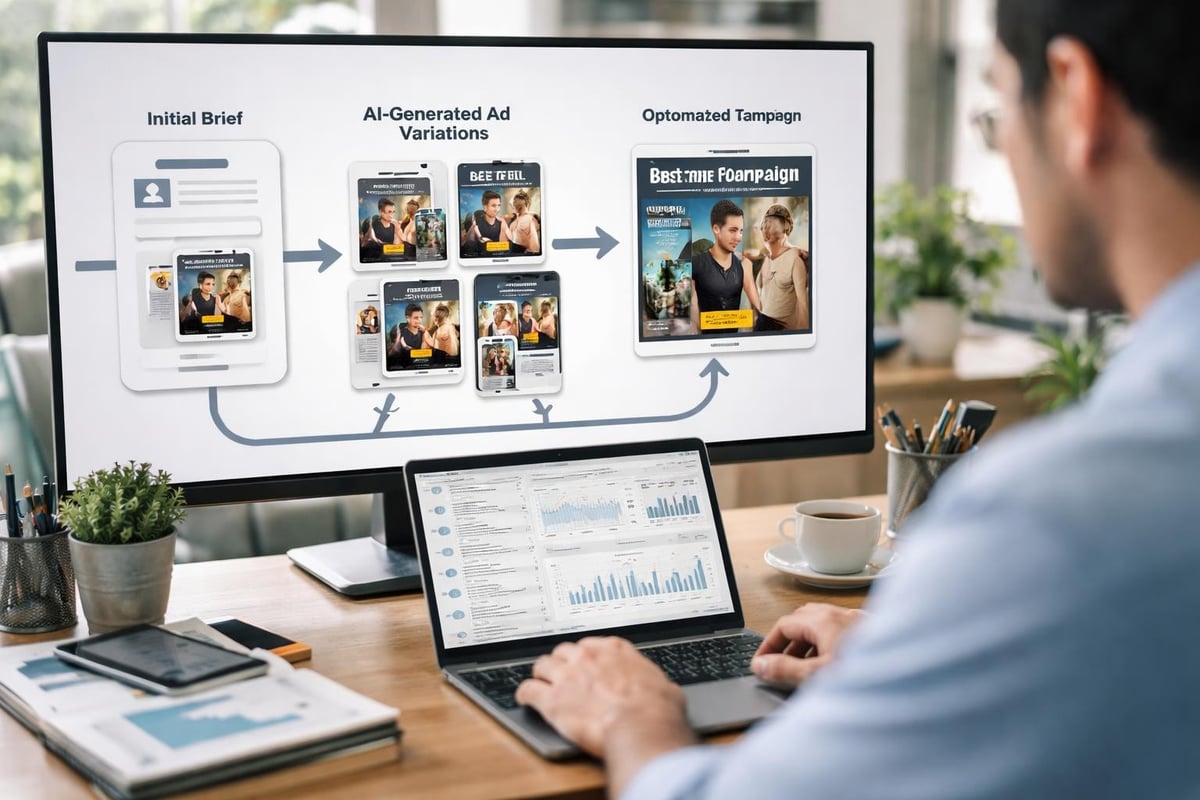
Creating professional visual assets historically required graphic design expertise or expensive agency relationships. AI-powered design platforms now generate ad images, infographics, and video content tailored to financial advisory messaging.
These tools analyze high-performing financial services ads, identify visual patterns that drive engagement, and apply those insights to new creative development. Advisors can produce campaign-ready assets in minutes rather than days.
Performance Optimization and Testing
The true power of AI for marketing campaigns emerges in continuous performance optimization. While traditional campaigns require manual monitoring and adjustment, AI systems make thousands of micro-optimizations automatically.
Real-Time Bidding and Budget Allocation
AI algorithms monitor campaign performance across platforms, shifting budget toward highest-performing channels and audiences. If LinkedIn campaigns generate better-quality leads than Facebook for a retirement planning offer, the system automatically reallocates spending.
This dynamic optimization happens continuously throughout campaign lifecycles:
- Morning performance analysis identifies overnight trends
- Midday adjustments respond to early engagement patterns
- Evening optimization prepares for next-day performance
- Weekly strategic shifts realign with broader objectives
Financial advisors benefit from this constant attention without dedicating staff time to campaign monitoring.
Multivariate Testing at Scale
Traditional A/B testing compares two variations to determine winners. AI for marketing campaigns conducts multivariate testing across dozens of elements simultaneously, including headlines, images, calls to action, audience segments, and placement options.
| Element Type | Variables Tested | Optimization Speed |
|---|---|---|
| Headlines | 15-20 variations | 24-48 hours |
| Visual assets | 10-15 options | 48-72 hours |
| Audience segments | 8-12 segments | 72-96 hours |
| Call-to-action | 5-8 variations | 24-36 hours |
The system identifies winning combinations far faster than manual testing, accelerating time to optimal campaign performance. Advanced AI analytics reveal not just what works, but why specific combinations resonate with particular audience segments.
Channel-Specific AI Applications
Different marketing channels present unique opportunities for AI optimization. Financial advisors typically leverage multiple channels simultaneously, making cross-platform intelligence particularly valuable.
Social Media Advertising
AI for marketing campaigns excels in social media environments where audience behavior constantly evolves. The technology identifies optimal posting times, content formats, and messaging approaches for each platform.
LinkedIn campaigns targeting business owners and executives benefit from AI-powered professional network analysis. The systems identify prospects based on job changes, company growth patterns, and engagement with financial content.
Facebook and Instagram require different approaches focused on life events and interest-based targeting. AI identifies users experiencing wealth transitions such as home purchases, business sales, or inheritance receipts.
Search Engine Marketing
Google Ads campaigns benefit tremendously from AI optimization. The technology manages keyword bidding, ad copy testing, and landing page matching to maximize quality scores while minimizing cost per click.
Recent developments like Google’s experimental AI tools specifically help small and medium-sized businesses scale marketing efforts rapidly, making enterprise-level capabilities accessible to independent advisors.
Traditional Media Enhancement
Even traditional advertising channels benefit from AI integration. AI-powered advertising platforms now deliver targeted TV, radio, and streaming recommendations based on viewer behavior and campaign objectives.
Financial advisors expanding into broadcast media can leverage AI to identify programs and time slots where their ideal clients consume content, optimizing media buying decisions previously requiring extensive research and experience.
Measuring ROI and Campaign Attribution
Demonstrating marketing return on investment challenges many financial advisors. AI for marketing campaigns provides sophisticated attribution modeling that tracks prospect journeys from initial exposure through client conversion.
Multi-Touch Attribution Modeling
Prospective clients typically interact with advisor marketing multiple times before scheduling consultations. They might see a Facebook ad, visit the website, receive email nurture sequences, and attend a webinar before converting.
AI attribution models assign appropriate credit to each touchpoint:
- First-touch attribution identifies initial awareness channels
- Last-touch analysis reveals conversion drivers
- Linear modeling distributes credit equally across touchpoints
- Time-decay attribution weights recent interactions more heavily
- Position-based models emphasize first and last interactions
Understanding true attribution enables smarter budget allocation. Advisors discover which channels deserve increased investment and which deliver minimal impact despite consuming resources.
Lifetime Value Prediction
Beyond initial conversion tracking, AI predicts client lifetime value based on acquisition source and early engagement patterns. This capability helps advisors identify which marketing channels attract most valuable long-term relationships versus one-time engagements.
The technology analyzes historical client data to identify predictive patterns. Clients acquired through certain campaigns or channels may demonstrate higher average assets under management, longer retention rates, or greater referral activity.

Ethical Considerations and Compliance
Financial advisors must navigate complex regulatory environments while implementing AI for marketing campaigns. The technology offers tremendous capability but requires careful governance to maintain compliance.
Regulatory Compliance Safeguards
AI systems must incorporate compliance checks that prevent prohibited claims, ensure required disclosures, and maintain appropriate documentation. Financial advisors should implement approval workflows where AI-generated content receives human review before publication.
Key compliance considerations include:
- Performance claims requiring specific disclaimers
- Testimonial usage and required disclosures
- Record retention for advertising materials
- Fair and balanced presentation requirements
- Suitability of offers for target audiences
Working with marketing tools designed for financial advisors ensures platform providers understand industry-specific requirements and build appropriate safeguards into their systems.
Data Privacy and Security
AI for marketing campaigns relies on prospect data for targeting and personalization. Financial advisors must ensure data collection, storage, and usage comply with privacy regulations including GDPR, CCPA, and industry-specific requirements.
Transparent privacy policies, secure data handling, and appropriate consent mechanisms protect both prospects and advisor practices. AI systems should include data retention policies that automatically purge information according to regulatory requirements and business needs.
Future Trends and Emerging Capabilities
The AI for marketing campaigns landscape continues evolving rapidly. Financial advisors who understand emerging trends can position themselves to leverage new capabilities as they mature.
Conversational AI and Chatbots
Advanced conversational AI now handles initial prospect interactions, answering questions about services, scheduling consultations, and qualifying leads. These systems maintain natural dialogue while gathering information that helps advisors prepare for meaningful conversations.
The technology integrates with broader marketing campaigns, providing personalized experiences that extend beyond static ad content into interactive engagement.
Predictive Campaign Planning
Next-generation AI systems analyze market conditions, competitive activities, and seasonal patterns to recommend optimal campaign timing and messaging. Rather than simply optimizing existing campaigns, these tools suggest proactive campaign strategies based on predicted opportunity windows.
Financial advisors might receive recommendations to launch retirement planning campaigns when market volatility increases, knowing historical data shows prospect responsiveness rises during uncertain economic periods.
Voice and Audio Marketing
As voice assistants and audio content consumption grow, AI for marketing campaigns increasingly supports podcast advertising, voice search optimization, and audio content creation. Financial advisors can reach prospects during commutes, workouts, and other audio-consumption moments.
The technology helps identify relevant podcasts for sponsorship, creates audio ad scripts, and measures campaign performance across audio channels.
Building Internal AI Marketing Capabilities
Financial advisors committed to long-term success with AI for marketing campaigns must develop internal capabilities rather than relying entirely on external vendors. This approach ensures strategic control and continuous improvement.
Team Training and Development
Even practices outsourcing campaign execution benefit from internal AI literacy. Understanding capabilities, limitations, and best practices enables better vendor management and strategic decision-making.
Training should cover:
- Fundamental AI concepts and terminology
- Platform-specific capabilities for tools in use
- Performance metric interpretation and optimization strategies
- Compliance requirements specific to AI-generated content
- Emerging trends and future capabilities
Vendor Partnership Management
Most financial advisors partner with specialized marketing agencies or technology platforms rather than building entirely in-house capabilities. Effective partnerships require clear communication, defined success metrics, and regular performance reviews.
Establish expectations around:
- Campaign strategy development and approval processes
- Performance reporting frequency and detail level
- Compliance review and approval workflows
- Budget management and adjustment protocols
- Innovation testing and new feature adoption
Strong vendor relationships create collaborative environments where AI technology continuously improves campaign performance while advisors maintain strategic control and regulatory compliance.
AI for marketing campaigns represents the most significant advancement in financial advisor marketing in decades, offering capabilities that transform how practices attract and convert ideal clients. The technology delivers personalization at scale, continuous optimization, and sophisticated attribution that were impossible just years ago. For financial advisors ready to leverage these capabilities, Ryan Cook provides specialized ad services and creation designed specifically for your industry's unique needs, helping you implement AI-powered campaigns that drive measurable growth while maintaining full compliance with industry regulations.